How Klarna Makes Money


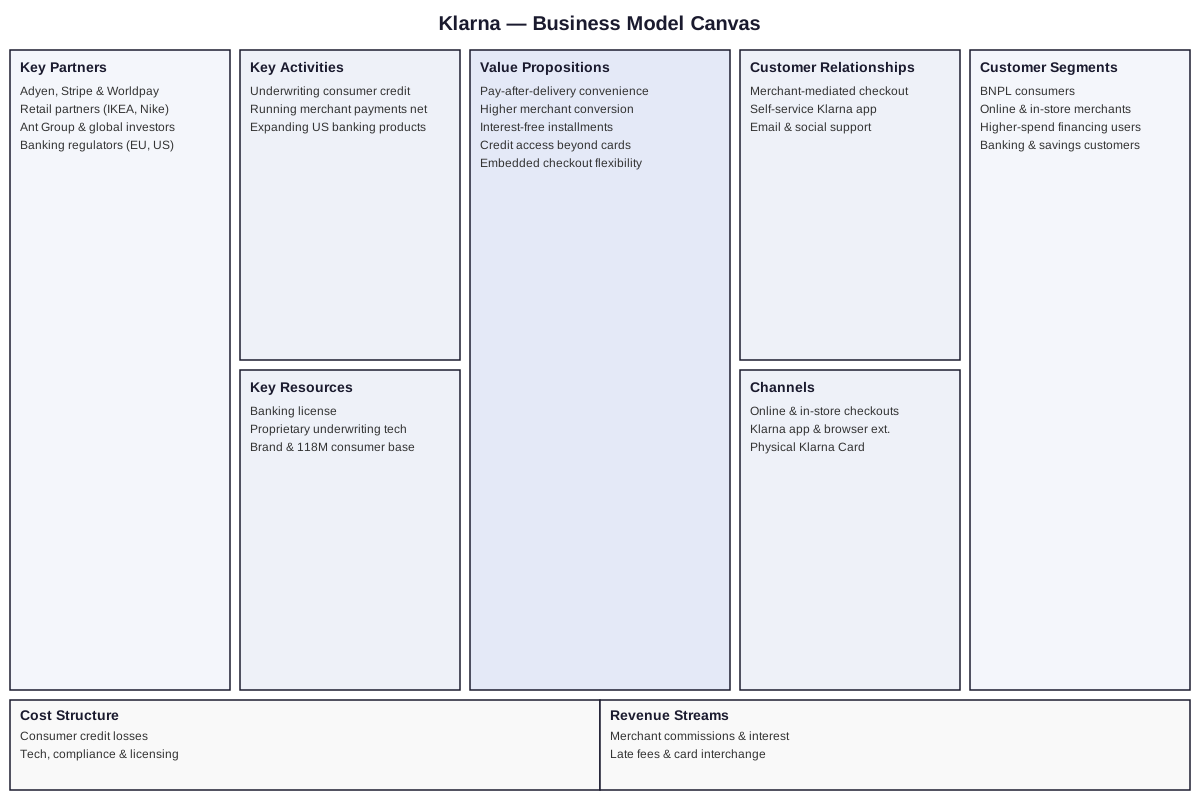
Klarna, a Swedish financial technology (fintech) company, lets shoppers split purchases into installments or pay after delivery, a model known as buy now, pay later (BNPL). Founded in Stockholm in 2005 by Sebastian Siemiatkowski, Niklas Adalberth and Victor Jacobsson, Klarna grew from an invoice-based checkout tool into a global digital bank. The company listed on the New York Stock Exchange (NYSE) on September 10, 2025, under the ticker KLAR, closing its debut trading day near a $19 billion valuation. In 2025, Klarna processed $127.9 billion in gross merchandise volume (GMV) across 118 million active consumers and 966,000 merchants, generating $3.5 billion in revenue. Its money comes mainly from merchant commissions, consumer financing interest, late fees and card interchange. This article traces that revenue model, its ownership structure and how each piece fits into a Business Model Canvas.
How does Klarna make money?
Klarna earns most of its revenue from merchant commissions, a flat fee plus a percentage of each transaction charged when a shopper checks out using Klarna. Interest on longer financing plans, late payment fees from consumers who miss due dates and interchange from the Klarna Card add the rest. Shoppers who use the standard Pay in 4 or 30-day options pay nothing extra as long as they repay on schedule.
When did Klarna go public?
Klarna listed on the New York Stock Exchange (NYSE) on September 10, 2025, under the ticker KLAR. The offering priced at $40 a share, above its guided range, valuing the company near $15 billion at the offer price. Shares closed the first trading day up 15%, pushing Klarna's market value to roughly $19.65 billion.
Who owns Klarna after its IPO?
Sequoia Capital remains Klarna's largest outside shareholder, holding close to 20% of shares after the listing. Co-founder Victor Jacobsson and investment firm Heartland A/S each hold about 8%, while CEO Sebastian Siemiatkowski holds roughly 7%. Commonwealth Bank of Australia, Permira, Ant Group and other long-term investors hold smaller stakes built up over Klarna's two decades as a private company.
A Stockholm Startup Turns Twenty
Klarna started in Stockholm in 2005, when Sebastian Siemiatkowski, Niklas Adalberth and Victor Jacobsson built a checkout tool that let online shoppers order first and pay an invoice within 30 days. Siemiatkowski developed the idea while finishing his degree at the Stockholm School of Economics, at a time when handing a credit card number to an unfamiliar website still made many shoppers nervous. Letting people receive goods before paying removed that friction and gave merchants a way to raise conversion without cutting prices. The approach worked well enough that Klarna spent the next two decades expanding from an invoice provider into a licensed bank offering cards, savings accounts and installment financing across dozens of markets.1
Split Payments Replace One-Time Cards
Klarna's core product lets shoppers split a purchase into four interest-free installments or defer the full payment for 30 days, both funded by Klarna rather than a bank card issuer. Larger purchases can move into longer financing plans that run up to 36 months, where Klarna charges interest set largely by the shopper's credit profile. The Klarna Card, a virtual and physical card linked to Apple Pay or Google Wallet, extends the same flexible payment options into physical stores at retailers such as Sephora, IKEA and Nike. Each format shifts payment timing without asking merchants to change their existing checkout systems, which keeps merchant integration simple even as consumer options multiply.
Wall Street Finally Says Yes
Klarna spent years signaling an initial public offering (IPO) before it actually filed and the listing finally arrived on September 10, 2025, when shares began trading on the New York Stock Exchange (NYSE) under the ticker KLAR. The offering priced at $40 a share, above the company's guided range of $35 to $37 and raised about $1.37 billion by selling roughly 34.3 million shares. Siemiatkowski marked the moment with a message to employees describing the company's origins:
When we started Klarna back in 2005, it was just a wild idea — me, Niklas and Victor, fumbling around, trying to make shopping and payments smoother for people2
The listing closed two decades of private fundraising rounds and gave Klarna's employees, founders and venture backers a public market to value their stakes.
The Debut Beat Expectations
Shares opened well above the offer price on debut day, touching $52 before settling to close at $45.82, a 15% gain over the $40 issue price that pushed Klarna's market value to roughly $19.65 billion. The debut ranked as the largest U.S. IPO of 2025 and one of the largest European fintech listings on record, a notable outcome for a company that had delayed its public offering more than once amid choppy markets. Klarna followed the listing with its first earnings report as a public company in November 2025, topping revenue estimates on the back of U.S. growth in its banking and Pay in 4 products. That performance helped quiet early doubts about whether investor enthusiasm on debut day would hold once quarterly results started arriving.3
Sequoia and the Founders Still Call the Shots
Sequoia Capital, a backer since 2010, emerged from the IPO as Klarna's largest outside shareholder with close to 20% of shares, a stake valued near $3.5 billion at the offer price. Co-founder Victor Jacobsson holds about 8%, matched closely by Danish investment firm Heartland A/S, while chief executive officer (CEO) Sebastian Siemiatkowski retained roughly 7% and Commonwealth Bank of Australia holds close to 5%. Michael Moritz, a longtime Sequoia partner, chairs Klarna's board, giving the firm both an equity stake and a formal governance role. That concentration means a small group of early investors and founders still shapes major strategic decisions despite Klarna's new status as a publicly traded company.4
Merchant Fees Fund Most of the Business
Merchant commissions remain Klarna's largest revenue source: retailers pay a flat fee plus a percentage of each transaction, with the percentage varying by payment option and running higher for interest-free installment plans than for financed purchases. Interest on longer financing plans, late fees from consumers who miss payment deadlines and interchange earned on Klarna Card transactions round out the model. Full-year 2025 results filed with U.S. regulators showed $127.9 billion in gross merchandise volume (GMV), up 22% from 2024 and $3.5 billion in total revenue, up 25%, spread across 118 million active consumers and 966,000 merchants. Adjusted operating profit reached $65 million, a 1.9% margin, evidence that the company can generate a profit at scale even as it keeps expanding into new markets and products.5
Payment Processors Widen the Funnel
Klarna increasingly reaches merchants through payment processors rather than by selling its checkout software directly. Its partnership with Adyen brought Klarna's flexible payment methods to all 450,000 of Adyen's in-store terminals across Europe, North America and Australia, while an expanded Stripe integration let merchants in 25 countries switch on Klarna instantly. A separate agreement with Worldpay connects Klarna to roughly one million merchants through Worldpay's existing payment dashboard, without requiring those merchants to build a direct integration. Together these deals added more than 100,000 new retailers to Klarna's network in 2024 alone, a shift that trades some direct merchant control for faster distribution across processors most retailers already use.6
Key Partners
Klarna depends on payment processors including Adyen, Stripe and Worldpay to plug its BNPL options into merchant checkouts without custom integration work. Retail partners such as IKEA, Nike, Sephora and Foot Locker anchor the Klarna Card network, while Ant Group and other long-term investors help extend Klarna into new regions. Banking regulators across Europe and the United States also function as partners of necessity, since Klarna operates as a licensed bank.
Key Activities
Klarna's central activity is underwriting consumer credit at checkout, deciding in seconds whether to extend Pay in 4, 30-day or financed terms to a shopper. Running and maintaining the payments network that connects nearly a million merchants to that credit decision is a close second. Expanding U.S. banking products, including deposit accounts and debit cards, has become a growing activity as Klarna pushes beyond pure BNPL.
Key Resources
Klarna's banking license lets it hold deposits and extend credit directly rather than through a partner bank, a resource most BNPL rivals lack. Its underwriting technology, refined over two decades of transaction data, drives approval decisions and credit risk pricing. Brand recognition among 118 million consumers and a balance sheet built through public and private funding rounds round out its key resources.
Value Propositions
For shoppers, Klarna offers convenience through saved payment details and the option to receive goods before paying, reducing the risk of paying for something that never arrives. For merchants, Klarna's checkout options raise conversion rates and average order value compared with requiring full payment upfront. Klarna also gives consumers with thin or damaged credit files a path to short-term financing that traditional credit cards might deny.
Customer Relationships
Most of Klarna's relationship with shoppers begins inside a merchant's checkout rather than through direct marketing, since consumers first encounter Klarna as a payment option at the point of sale. The Klarna app then takes over, letting users track payments, adjust due dates and manage their Klarna Card in one place. Email, in-app messaging and social media support handle account issues and disputes outside the merchant relationship.
Channels
Online and in-store merchant checkouts remain Klarna's primary channel, reaching shoppers exactly where they decide to buy. The Klarna app and browser extension let consumers shop across retailers outside a single merchant's site and still access Klarna's payment options. The Klarna Card extends the same channel into physical retail locations that have not built a direct Klarna integration.
Customer Segments
Klarna serves two interdependent segments: consumers who want flexible payment timing and merchants who want higher conversion without extending credit themselves. Within the consumer segment, Klarna spans budget-conscious shoppers using interest-free installments and higher-spending customers using longer financed plans. Its expansion into deposit accounts and banking products adds a smaller segment of customers using Klarna as a primary bank rather than a checkout tool.
Cost Structure
Credit losses from consumers who fail to repay financed or installment purchases represent Klarna's largest variable cost, since the company pays merchants upfront regardless of whether shoppers eventually pay. Technology and engineering costs support the underwriting models and banking infrastructure that process millions of daily transactions. Licensing, compliance and regulatory costs add up quickly given Klarna's operations as a bank across multiple jurisdictions.
Revenue Streams
Merchant commissions, a flat fee plus a percentage of transaction value, generate the largest share of Klarna's revenue. Interest charged on longer financing plans and late fees from missed payments add a second major stream tied directly to consumer credit behavior. Interchange income from Klarna Card transactions contributes a smaller but growing stream as card usage expands across partner retailers.
Klarna's business model rests on a simple exchange: merchants pay for access to shoppers who convert more often when payment feels flexible and Klarna absorbs the credit risk in between. Merchant commissions and interest on longer financing plans, not fees charged to shoppers using standard installment plans, fund most of the company. The 2025 listing on the New York Stock Exchange gave Klarna public currency and outside scrutiny, while Sequoia Capital and the founding team retained sizable stakes and influence over strategy. Partnerships with Stripe, Adyen and Worldpay now matter as much as the Klarna app itself, since most shoppers meet Klarna inside someone else's checkout. Growth still depends on consumers repaying on time and merchants accepting Klarna's commission rates over cheaper alternatives. Both conditions have held through 2025, but neither is guaranteed as competition from Affirm, PayPal and bank-led installment products intensifies across Klarna's core markets.
Citation
Cite this article
Sridharan, M. A. (2023, February 3). How Klarna Makes Money. Think Insights. https://thinkinsights.net/strategy/how-klarna-makes-money (Accessed [[ACCESS_DATE]])
Sridharan, Mithun A. "How Klarna Makes Money." Think Insights, 3 Feb. 2023, https://thinkinsights.net/strategy/how-klarna-makes-money. Accessed [[ACCESS_DATE]].
Mithun A. Sridharan, "How Klarna Makes Money," Think Insights, February 3, 2023, https://thinkinsights.net/strategy/how-klarna-makes-money. Accessed [[ACCESS_DATE]].
Sridharan, M.A. (2023) 'How Klarna Makes Money', Think Insights. Available at: https://thinkinsights.net/strategy/how-klarna-makes-money (Accessed: [[ACCESS_DATE]]).
M. A. Sridharan, "How Klarna Makes Money," Think Insights, 2023. [Online]. Available: https://thinkinsights.net/strategy/how-klarna-makes-money. [Accessed: [[ACCESS_DATE]]].
Sridharan MA. How Klarna Makes Money. Think Insights. Published February 3, 2023. Accessed [[ACCESS_DATE]]. https://thinkinsights.net/strategy/how-klarna-makes-money
Test Your Knowledge
How Klarna Makes Money
Challenge yourself on the concepts from this article and see how well you understood them.
Subscribers get weekly quizzes and insights — subscribe free
Sponsor this article
Partner with Think Insights
Reach 50,000+ business leaders, consultants, and strategists. Feature your brand alongside expert articles on strategy, leadership, and digital transformation.
Become a Sponsor