How BlackRock Makes Money


BlackRock manages more money than any other firm in the world, with assets under management crossing $14 trillion by the end of 2025. The business rests on a simple mechanic: charge a fee, expressed as a percentage of assets, for managing other people's money. That fee scales with markets and inflows rather than with headcount, which is why a firm with a workforce smaller than many regional banks can generate outsized profits. Larry Fink, Susan Wagner and six co-founders started the firm in 1988 to sell risk analytics before they ever managed a dollar for clients. That analytics engine, now called Aladdin, still underpins the company today, licensed to other institutions as a second business line alongside fund management.
How does BlackRock make most of its money?
BlackRock earns the bulk of its revenue from investment management fees charged as a percentage of assets under management. Additional revenue comes from technology licensing of its Aladdin platform, performance fees on select strategies and securities lending through its iShares ETF business.
What is Aladdin and why does it matter to BlackRock's model?
Aladdin is BlackRock's risk management and portfolio analytics platform, originally built for internal use before becoming a licensed product for other asset managers, banks and insurers. It gives BlackRock a second, higher-margin revenue stream that is less tied to market cycles than asset management fees.
Who runs BlackRock and who owns it?
Larry Fink, one of the firm's co-founders, remains chairman and chief executive. As a publicly traded company, BlackRock is owned by shareholders, with large index fund managers such as Vanguard among its top institutional holders.
A firm built to sell risk analytics first
Larry Fink, Robert Kapito, Susan Wagner and five other partners started BlackRock in 1988 inside a single room at Blackstone, the private equity firm that provided seed capital. Fink had spent years at First Boston trading mortgage-backed securities and had personally overseen a trade that lost the bank $100 million after failing to anticipate an interest rate move. That loss shaped how he built BlackRock: the firm's founding pitch to institutional clients was rigorous risk measurement, not stock-picking flair. The founders built proprietary systems to model fixed-income portfolios down to the level of individual cash flows, and that system eventually became Aladdin, the platform BlackRock still licenses to competitors today.
BlackRock separated from Blackstone in 1994 after a dispute over compensation and strategy, taking the name BlackRock with it. The firm went public on the New York Stock Exchange in 1999, raising capital that funded a string of acquisitions. The most consequential came in 2009, when BlackRock bought Barclays Global Investors, the owner of the iShares ETF business, for $13.5 billion in the middle of the financial crisis. That single deal turned BlackRock from a large fixed-income manager into the dominant player in exchange-traded funds, a product category that has since reshaped how both retail and institutional investors build portfolios.
BlackRock's founders built a risk-analytics business before they built an asset-management business, and the sequence still explains how the firm makes money today.
Two businesses under one roof
BlackRock generates revenue two distinct ways: managing money and selling the technology it built to manage that money. The investment management side charges basis-point fees on assets held in mutual funds, ETFs and separately managed accounts, with iShares alone holding a large share of global ETF assets. The technology side, Aladdin, is licensed to other asset managers, insurers and banks that use it for portfolio risk monitoring rather than building comparable systems internally.1 This dual structure means BlackRock earns from the growth of markets generally, since fees rise with asset values, and separately from other financial institutions' operating budgets, since Aladdin subscriptions are largely insulated from short-term market swings.
Passive investing reshaped the fee model
Fees on index funds and ETFs are a fraction of what active fund managers charge, often in the range of a few basis points versus the roughly 1% typical of actively managed mutual funds decades earlier. BlackRock leaned into that compression rather than fighting it, betting that market share gains in passive products would offset thinner margins per dollar managed. The bet worked at scale: iShares became the largest ETF provider globally, and BlackRock's low per-unit costs let it operate profitably at fee levels that would strain smaller competitors.2 Vanguard pursued a similar low-fee strategy under a different ownership structure, since Vanguard's funds own the parent company, creating persistent competitive pressure between the two firms on pricing.
Institutional clients anchor the revenue base
Retail investors buy BlackRock products through brokers and 401(k) platforms, but the largest, most durable revenue comes from institutional clients: pension funds, sovereign wealth funds, insurers and corporations that place large mandates with the firm for years at a time. These relationships carry lower client-acquisition costs per dollar managed than retail distribution and tend to be stickier, since switching a pension fund's manager involves a lengthy due diligence process. BlackRock has also built a specific advisory relationship with governments, most visibly the U.S. Federal Reserve, which hired BlackRock to manage emergency bond-buying programs during both the 2008 financial crisis and the 2020 pandemic response.3 That work drew criticism from lawmakers who questioned whether a private asset manager should hold that level of access to monetary policy operations.
ESG investing brought both growth and backlash
BlackRock built a large sustainable-investing product lineup through the 2010s and positioned Fink as a vocal advocate for climate-related disclosure in his annual letters to CEOs. That stance drew business from clients seeking environmental, social and governance (ESG) options, but it also triggered a political backlash. Several U.S. states pulled public pension assets from BlackRock over objections to its climate positioning, while other critics argued the firm had not gone far enough on emissions targets.4 Fink scaled back the ESG language in subsequent shareholder letters, illustrating how a firm managing money on behalf of politically diverse clients has limited room to take public positions on contested issues without losing business somewhere on the spectrum.
Scale created its own regulatory question
BlackRock's combined size in passive index funds means it holds meaningful voting stakes in nearly every large public company in the United States, a position no other single asset manager occupies at the same scale. That concentration raised a policy debate over whether BlackRock, Vanguard and State Street collectively exercise outsized influence over corporate governance decisions through proxy voting, even though the shares are held on behalf of millions of underlying fund investors rather than owned outright.5 BlackRock responded by expanding "voting choice" programs that let institutional and some individual investors direct how their shares are voted rather than defaulting to BlackRock's own guidelines, a change aimed at defusing the criticism without giving up the underlying asset management relationship.
Growth increasingly points toward private markets
Index and ETF fees, while durable, compress over time as competition pushes prices down further. BlackRock's response has been to push into private markets, where fees are substantially higher and less exposed to public benchmark pricing. The firm paid roughly $12.5 billion for infrastructure investor Global Infrastructure Partners in a deal completed in 2024, then agreed to acquire private credit manager HPS Investment Partners in a transaction valued near $12 billion, closing in 2025.6 These deals reflect a strategic shift: rather than compete purely on the lowest possible fee, BlackRock is building a business mix where a growing share of revenue comes from alternative assets and technology, both of which carry pricing power that plain index funds no longer do.
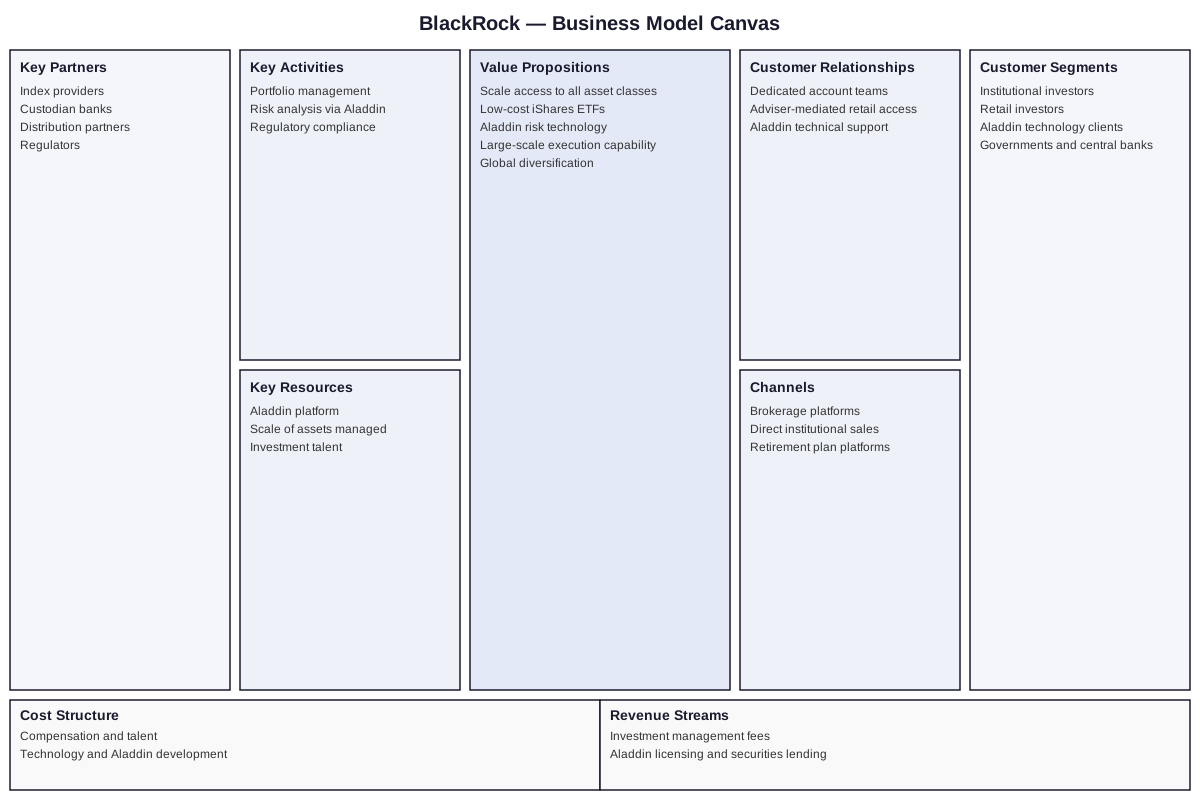
Key Partners
BlackRock's key partners include the stock exchanges and index providers whose benchmarks underpin its ETF products, custodian banks that hold client assets, and technology vendors that support Aladdin's infrastructure. Regulators across the jurisdictions where BlackRock operates function as a constant counterpart, given the firm's size and its role managing money for pension funds and government entities. Distribution partners, including wirehouses, registered investment advisers and retirement plan administrators, place BlackRock products in front of retail and workplace investors. Research and data providers supply the market information Aladdin's risk models depend on.
Key Activities
Portfolio management sits at the center of BlackRock's activities, spanning passive index replication, active fixed-income strategies and alternative investment mandates. Risk analysis runs continuously across client portfolios through Aladdin, both for BlackRock's own funds and for the outside institutions that license the platform. Sales and relationship management occupy substantial resources given the size and complexity of institutional mandates, which often require ongoing reporting and consultation. Regulatory compliance and reporting are constant activities given BlackRock's footprint across dozens of countries with different securities laws.
Key Resources
Aladdin is BlackRock's most distinctive resource, a risk and portfolio management system that took decades to build and would be difficult for a competitor to replicate quickly. The firm's scale itself functions as a resource, since larger asset pools let BlackRock negotiate lower trading costs and spread fixed technology expenses over a bigger base. Its workforce of investment professionals, quantitative researchers and client-facing teams carries institutional knowledge built over decades of managing client relationships. Brand recognition, reinforced by Fink's public visibility, gives BlackRock credibility when pitching new institutional mandates.
Value Propositions
For institutional clients, BlackRock offers scale-driven access to nearly every asset class through a single relationship, reducing the need to manage dozens of separate manager relationships. Retail investors get low-cost access to diversified markets through iShares ETFs, without needing to pick individual securities. Other financial institutions get Aladdin as an alternative to building comparable risk infrastructure internally, saving years of development time. Governments and central banks get a manager capable of executing large, sensitive market operations, such as emergency bond purchases, at short notice.
Customer Relationships
BlackRock manages institutional relationships through dedicated account teams that handle portfolio construction, reporting and periodic strategy reviews over multi-year mandates. Retail investors interact with BlackRock indirectly, mostly through financial advisers, brokerage platforms or retirement plan interfaces rather than direct contact with the firm. Aladdin clients maintain an ongoing technical relationship involving implementation support, training and platform updates. Fink's annual letter to CEOs and to shareholders functions as a public-facing relationship channel that shapes how corporate clients and policymakers perceive the firm.
Channels
BlackRock distributes retail products through brokerage platforms, financial advisers and workplace retirement plans that offer its mutual funds and ETFs as investment options. Institutional mandates are won through direct sales teams and consultant relationships, since large pension funds and sovereign wealth funds typically use investment consultants to vet managers. The company's website and investor relations materials serve informational and reporting purposes for existing clients and shareholders. Conferences, industry events and Fink's public commentary function as channels for reaching both prospective clients and policymakers.
Customer Segments
Institutional investors, including pension funds, insurers, sovereign wealth funds and endowments, form BlackRock's largest and most stable customer base by assets managed. Retail investors access BlackRock products through ETFs and mutual funds distributed via brokers and retirement platforms. Financial institutions that license Aladdin, including competing asset managers and banks, form a distinct technology customer base separate from BlackRock's asset management clients. Governments and central banks occasionally engage BlackRock for advisory and execution services during periods of market stress.
Cost Structure
Compensation for investment professionals, technologists and client-facing staff represents BlackRock's largest expense category, consistent with an industry where talent retention drives performance. Technology investment, spanning Aladdin's development and the infrastructure supporting global trading operations, is a substantial and growing cost as the firm competes on platform capability as much as fund performance.
Revenue Streams
Investment management fees, charged as a percentage of assets under management, generate the majority of BlackRock's revenue and scale directly with market levels and net client inflows. Technology services revenue from Aladdin licensing, along with securities lending income tied to the iShares ETF business, provides a smaller but higher-margin complement to the core fee stream.
BlackRock's scale gives it leverage that smaller managers cannot replicate: lower per-unit costs, deeper index licensing relationships and a technology platform other institutions pay to use. That scale also draws scrutiny. Regulators and lawmakers in several states have questioned whether a firm with large passive stakes in thousands of companies wields too much influence over corporate voting, prompting BlackRock to expand options letting institutional clients vote their own shares. Fee compression in index products continues to squeeze margins, pushing the firm toward higher-fee private markets and technology licensing for growth. Its 2024 acquisitions of Global Infrastructure Partners and, in 2025, HPS Investment Partners signal where that growth is meant to come from. Whether BlackRock can keep expanding assets under management while defending its fee structure will shape its next decade as much as index investing shaped its first three.
Citation
Cite this article
Sridharan, M. A. (2020, October 5). How BlackRock Makes Money. Think Insights. https://thinkinsights.net/strategy/how-blackrock-makes-money (Accessed [[ACCESS_DATE]])
Sridharan, Mithun A. "How BlackRock Makes Money." Think Insights, 5 Oct. 2020, https://thinkinsights.net/strategy/how-blackrock-makes-money. Accessed [[ACCESS_DATE]].
Mithun A. Sridharan, "How BlackRock Makes Money," Think Insights, October 5, 2020, https://thinkinsights.net/strategy/how-blackrock-makes-money. Accessed [[ACCESS_DATE]].
Sridharan, M.A. (2020) 'How BlackRock Makes Money', Think Insights. Available at: https://thinkinsights.net/strategy/how-blackrock-makes-money (Accessed: [[ACCESS_DATE]]).
M. A. Sridharan, "How BlackRock Makes Money," Think Insights, 2020. [Online]. Available: https://thinkinsights.net/strategy/how-blackrock-makes-money. [Accessed: [[ACCESS_DATE]]].
Sridharan MA. How BlackRock Makes Money. Think Insights. Published October 5, 2020. Accessed [[ACCESS_DATE]]. https://thinkinsights.net/strategy/how-blackrock-makes-money
Test Your Knowledge
How BlackRock Makes Money
Challenge yourself on the concepts from this article and see how well you understood them.
Subscribers get weekly quizzes and insights — subscribe free
Sponsor this article
Partner with Think Insights
Reach 50,000+ business leaders, consultants, and strategists. Feature your brand alongside expert articles on strategy, leadership, and digital transformation.
Become a Sponsor