The Founder's Mentality


Diagnose your company on two axes, founder's mentality and scale, and fight the gravity pulling everything toward bureaucratic mediocrity. Only one in nine companies sustains growth for a decade, and most executives blame internal complexity rather than markets. Protect the insurgent culture while you scale, deliberately.
What is the growth paradox?
Growth creates complexity, and complexity kills growth. Bain research finds only one in nine companies sustains profitable growth for ten or more years, and the obstacles are mostly internal rather than market-driven.
What surprises executives about the research?
Companies missing growth targets blame themselves, not market conditions. Executives cite complexity, bureaucracy and talent gaps as root causes, a rare instance of leadership owning its dysfunction.
Where should a company sit on the two-by-two?
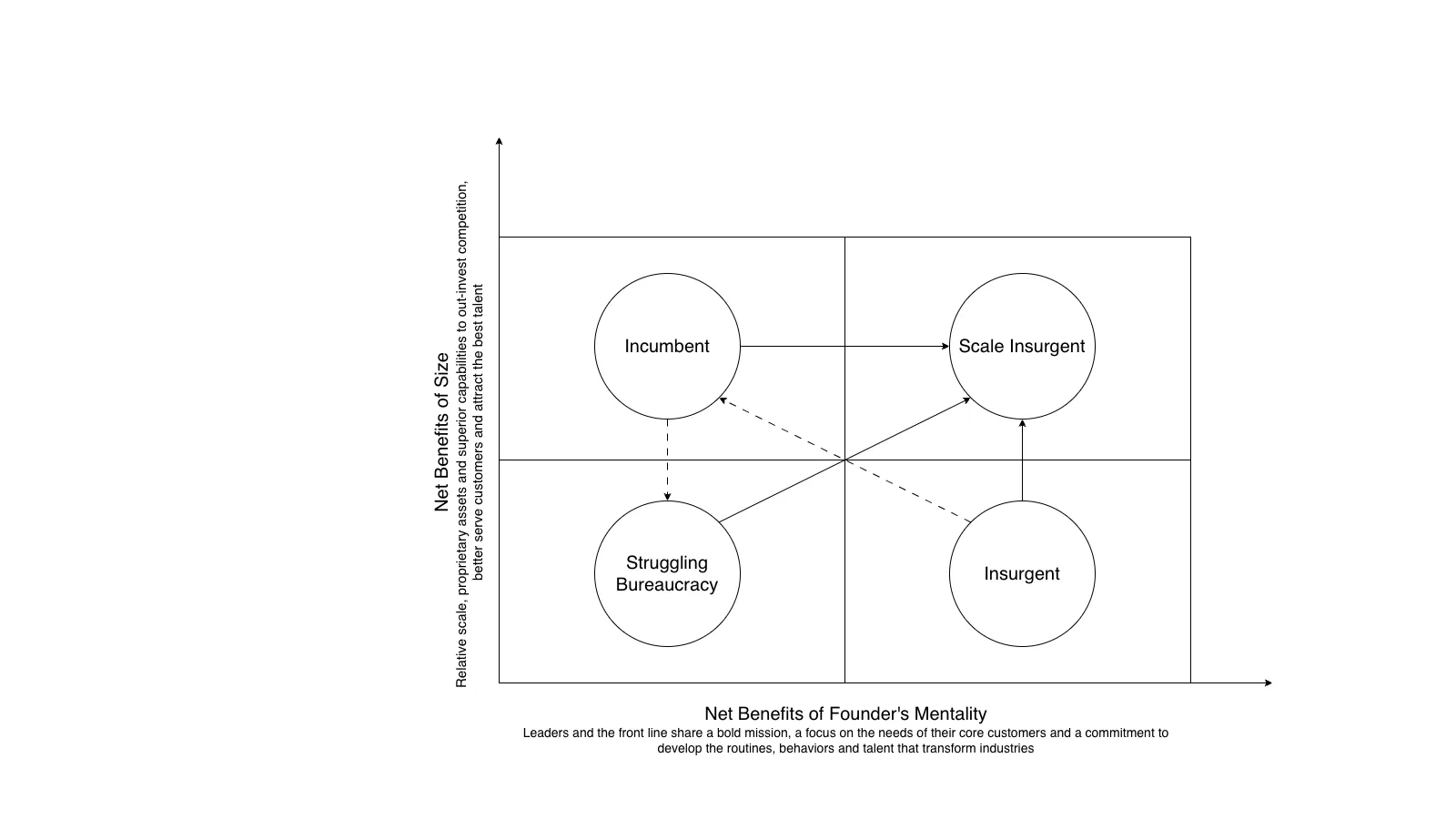
Top right: high founder's mentality and high scale. Strong culture, can-do attitude and profitability combined with global reach and economies of scale. Reaching it is enormously hard, which is the point.
A Framework Worth Geeking Out Over
Calling something a favorite framework may be the geekiest possible confession, and this one earns it. Bain & Company built a simple, elegant model describing how companies lose their way as they grow.1 The path from startup to global juggernaut is not a straight line, and Bain research shows only one in nine companies sustains growth for ten or more years. They call it the growth paradox: growth creates complexity, and complexity kills growth. Any consultant who has watched a client organization drown in its own processes will violently agree.
It's Me, Not You
The most surprising and universally relevant finding concerns blame. Bain research shows that most companies failing to reach their growth objectives blame themselves, not market conditions. This is refreshing, because executives rarely own up to their company's dysfunction or complacency. The cited obstacles are internal: complexity, bureaucracy and lack of talent. The pattern confirms a deeper truth about organizations. Culture trumps strategy in the long term, a theme long associated with Peter Drucker's thinking on management.2 Business is won or lost daily in the habits and practices of the front line. When the people closest to the customer succumb to complexity, confusion and waste, bad things happen quickly, and the market forgives none of it. The framework proves so useful in practice that it enters daily consulting vocabulary, gets shared with clients, features in internal presentations to large audiences and occasionally gets emailed, perhaps inappropriately, to a boss's boss. This is management consulting at its best: thoughtful, simple and actionable.
The Two-by-Two at the Core
The model rests on a two-by-two matrix with founder's mentality along one axis and scale along the other. The idea is brutally simple. Young companies act like insurgents against the status quo, carrying major passion and founder's mentality. They are gutsy, lean and formidable. As they grow and scale, they start losing their mojo, like a middle-aged former point guard gaining weight while telling all-star stories. That is the story of corporations too.
The best place to live is the top right: high on founder's mentality, meaning strong culture, good profitability and a can-do attitude, and high on scale and scope, meaning global reach, economies of scale and more competitive muscle than ever. Reaching that quadrant is enormously hard. Ask anyone who watched a company grow from five people past a hundred, and they will describe the trials in detail. Meanwhile gravity pulls toward the bottom left, powered by inertia, ennui and messy human nature. Worst case, a company loses the passion that made it aggressive, crafty and innovative. Worst case, it loses the scale that lowered its cost of competition and enabled cross-selling across markets. Worst case, it lands at the bottom left, bureaucratic and boring, a mess by any name.
Four Killers of Founder's Mentality
Bain names four forces that kill a small company's culture as it grows. The company cannot find the right people, and hiring dilutes the original standard. People forget who is responsible for what, and accountability blurs into committees. People stop talking about the customer, and internal matters crowd the agenda. And the founder sticks around too long, unable to adjust to what the company has become. Each killer works quietly, which is why leadership teams rarely notice the erosion until the insurgent energy is gone. The book-length treatment by Chris Zook and James Allen develops each failure mode with cases.3
Four Killers of Scale
The mirror-image list explains how large companies squander their structural advantages, and consultants see these in almost every client. A matrix organizational structure that does nothing except diffuse decisions. No sense of the end-to-end customer experience, because every function owns a fragment and nobody owns the whole. Process layered upon process, complexity for no reason, until compliance replaces judgment. And finally, losing the soul of the business, the point at which employees can no longer say what the company stands for. Scale should purchase speed and reach. Managed badly, it purchases meetings.
Using the Framework on Monday Morning
The matrix converts directly into management routines. Leadership teams can score themselves quarterly on both axes and track the drift, because direction matters more than position. Hiring committees can screen for insurgent traits, asking candidates when they last challenged a process rather than complied with one. Budget reviews can hunt scale-killers explicitly, cutting one process, one committee or one report each cycle to keep complexity honest. Customer time offers the simplest tonic of all. Executives who spend a day each month with front-line staff and real customers rebuild the owner's instincts that reports cannot transmit. None of these routines requires a transformation program. They require only the discipline to treat culture as an asset with a maintenance schedule.
Diagnose Yourself
Bain published a twenty-question survey for diagnosing your own company or client, measuring how much mojo remains and where the gaps sit. The diagnostic discipline matters more than the score. Consultants need to articulate to clients when they are losing their way: forgetting the nobler mission, degrading the customer experience, sinking into a doom loop of complexity, hiding behind matrix structures or dodging accountability. Each is a symptom of fading founder's mentality, and naming the drift early is most of the cure. The framework has since grown into a book, a video library and dozens of published examples, a thematic ecosystem of content that arguably outperforms what rival firms build around their ideas. Watch the eighteen-minute video if you can, or the three-minute version if patience runs short. Then apply the matrix to the company you know best, and answer honestly about which direction it is moving.
Growth creates complexity and complexity kills growth. The winners hold founder's mentality and scale simultaneously, resisting the pull toward the bureaucratic bottom left. Watch for the four killers on each axis, diagnose honestly and name the drift early. Culture beats strategy over the long term.
Citation
Cite this article
Sridharan, M. A. (2018, December 28). The Founder's Mentality. Think Insights. https://thinkinsights.net/insights/founders-mentality (Accessed [[ACCESS_DATE]])
Sridharan, Mithun A. "The Founder's Mentality." Think Insights, 28 Dec. 2018, https://thinkinsights.net/insights/founders-mentality. Accessed [[ACCESS_DATE]].
Mithun A. Sridharan, "The Founder's Mentality," Think Insights, December 28, 2018, https://thinkinsights.net/insights/founders-mentality. Accessed [[ACCESS_DATE]].
Sridharan, M.A. (2018) 'The Founder's Mentality', Think Insights. Available at: https://thinkinsights.net/insights/founders-mentality (Accessed: [[ACCESS_DATE]]).
M. A. Sridharan, "The Founder's Mentality," Think Insights, 2018. [Online]. Available: https://thinkinsights.net/insights/founders-mentality. [Accessed: [[ACCESS_DATE]]].
Sridharan MA. The Founder's Mentality. Think Insights. Published December 28, 2018. Accessed [[ACCESS_DATE]]. https://thinkinsights.net/insights/founders-mentality
Test Your Knowledge
The Founder's Mentality
Challenge yourself on the concepts from this article and see how well you understood them.
Subscribers get weekly quizzes and insights — subscribe free
Sponsor this article
Partner with Think Insights
Reach 50,000+ business leaders, consultants, and strategists. Feature your brand alongside expert articles on strategy, leadership, and digital transformation.
Become a Sponsor