IKIGAI


Consulting, like Investment Banking or similar high-profile professional services careers, is hard. It is particularly tough if you're a junior consultant. If don't keep your clients & bosses happy, your days are numbered. Typically, consultants experience variety in their projects, jam-packed & exciting workdays, exposure & access to key decision-makers, etc. As this HBR article2 notes, a consultant's work usually involves providing information, solving problems, effective diagnosis, recommending actions, or implementing changes. Hence, there is never a typical day in the life of a consultant. But, it's also not the easiest lifestyle.
What does Ikigai mean?
Ikigai is a Japanese concept combining iki (life) and gai (value or worth), meaning the value of life or a reason for being.
What are the four pillars of Ikigai?
The four pillars are Profession (what you are good at), Passion (what you love to do), Vocation (what you can be paid for), and Mission (what the world needs).
How do you apply Ikigai to a consulting career?
By honestly mapping your skills, enjoyment, earning potential, and societal contribution, you can assess whether consulting genuinely aligns with all four pillars or only some.
How long does it take to find your Ikigai?
There is no fixed timeline. It is recommended to let your model mature over time, revisiting it periodically rather than forcing immediate answers.
What should you do once you identify your Ikigai?
Create a multi-year plan, typically three years, outlining what to implement, skills to develop, people who can support you, and internal obstacles to address.
Consulting lifestyle entails frequent travel & sometimes, lengthy engagements. Consultants should be disciplined & tough enough to handle considerable workloads, prioritize tasks & put in long hours. It's certainly not for everybody. The Japanese model - Ikigai - helps you evaluate whether consulting is your vocation.
Up-or-out
In a report from Alexandra Michel, the ex-Goldman Sachs associate-turned professor found that junior bankers go through a cycle of physical abuse until they either dropout or take control. Consultants are engaged in something similar. Just as people leave banking because they can't stick the work & the lifestyle, so they quit consulting jobs too. As a consultant, not everything you do well is fun for you. Not everything you enjoy is paid for. what you want, what you are good at, what you find important is not necessarily congruent with what you can get paid for. That is why finding your Ikigai 3is important.
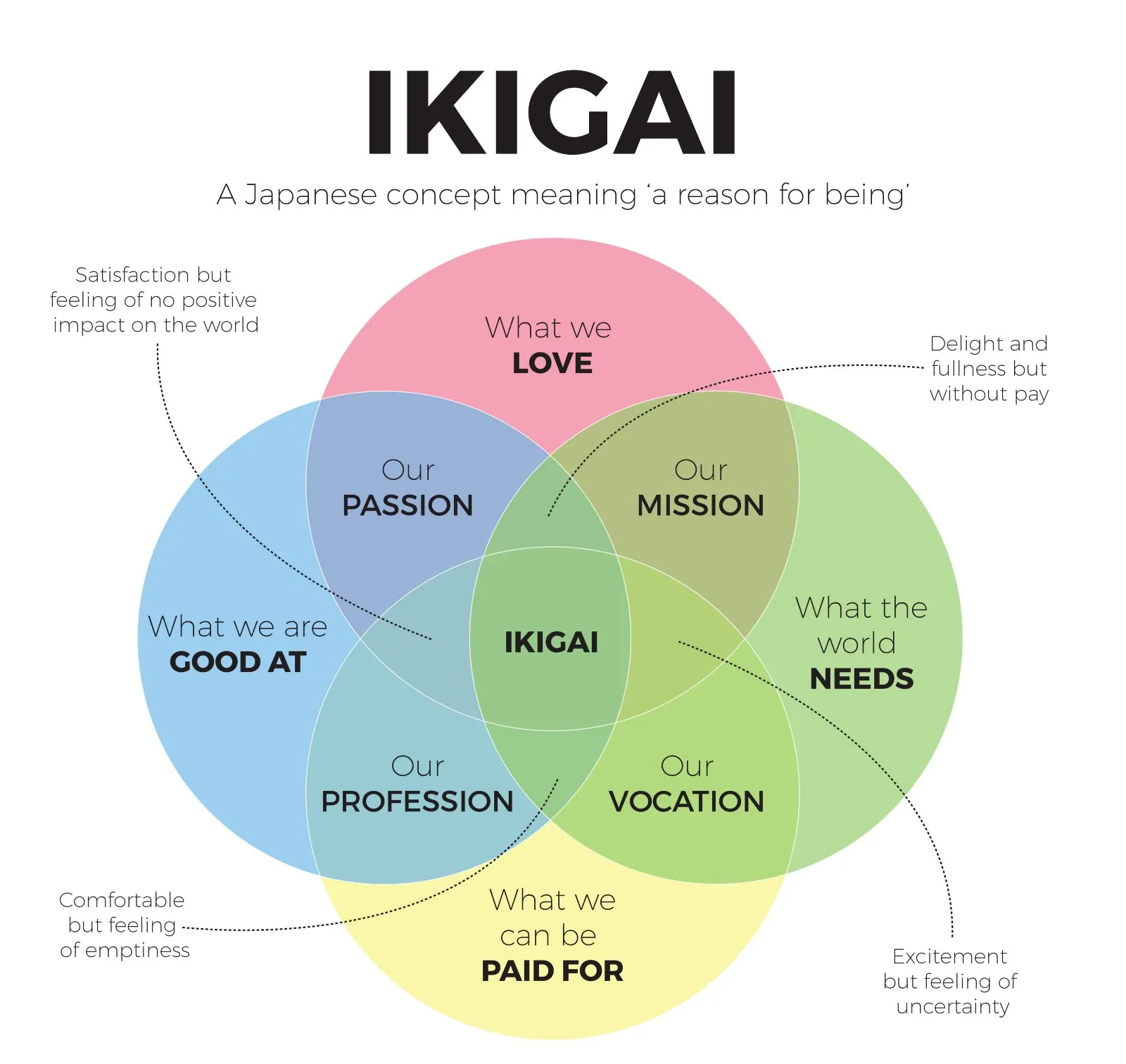
Ikigai
Ikigai is a Japanese concept made up of two words:
- Iki - which means life, and
- Gai, which means value or worth
In a nutshell, Ikigai is an intersection between these 4 pillars:
- Profession: What you are good at
- Passion: What you love to do
- Vocation: What you can be paid for
- Mission: What the world needs
Put together, these words mean value of life. In our consulting context, a reason for being. Our raison d'être.
Finding your Ikigai
This model works best if you make your own Ikigai model; there is no one-size-fits-all Ikigai. If you like to work with Post-its, then work with Post-its. Else, if you like to create mind maps, create a mind map. If you like to write or paint, then write or paint, then paint. Decide for yourself whichever format works for you. But, be completely honest with yourself; the shape must fit you. Once you've created your model, you may want to let your model marinate for a while. You can print out your model & hang it on the wall, use it as a desktop background, or have a photo of it on your phone. Then, work your way from the outside to the inside in the model.
Profession: What you are good at
For many, this is the simplest question. Ask yourself, what:
- Are you good at?
- Talents do you have?
- Are you better at than others?
- Have you always been able to do?
- Skills do you have through training / experience?
Write down everything that comes to mind. May be, you are an Excel superhero, bake the best cake or have a great eye for design. Write everything down. It can also be small or crazy skills!
Passion: What you love to do
That is the question we rarely ask ourselves is what:
- That you really enjoy?
- Can you do again and again without getting bored?
- Excites you most?
- Have you always enjoyed doing as a child?
- Can you talk about for hours?
Collect all ideas. Do not look at your answers to the questions from the first perspective. Look at each option as if it were the only one.
Vocation: What you can get paid for
Now the important question is: How can you make money? Not hypothetically & possibly, but very specifically. The skills that earn you money will change over time. As with everything in this post — and in life — there is no hard and fast rule. Everything is subject to change and evolution. Yet, reflect about:
- What jobs are there that you could do?
- What jobs did you already have or would you like to have?
- How will you earn income?
- If you could turn off your conscience, what could you do to support yourself?
Answer honestly again, unfiltered and as if there was only this option.
Mission: What the world needs
The fourth perspective is also about looking outwards. The questions you should ask yourself is what:
- Do you think the world needs right now?
- Topics are you concerned with?
- Problems do you want a solution for?
- Would you do if you were financially safe forever?
- Would you like to leave to the world?
- Moments make you feel fulfilled or vice-versa?
Hold on to your thoughts. Maybe it's a big thought like global justice. Perhaps, it's a small everyday moments like if I can make my friends laugh.
Find the intersections
Congratulations! You have now accomplished the most important thing. Now it's about integrating everything. Keep working from the outside in. Find the overlap between the four perspectives. For example, what are you good at and can you make money with it? What do you enjoy and what is needed by the world? Maybe you can find examples from your current life; maybe you can think of other people. Let your thoughts run wild. Gradually fill in the various fields. Maybe you want to talk to friends about it too. Give yourself more time for the ideas to consolidate. You don't have to find the answers right away. Sometimes, it takes a while to figure out what your Ikigai is. If you feel that you are thinking too hard, put your model aside for a week & focus on other topics4. Good ideas are like good wine; sometimes they need time to mature.
Implementing your Ikigai
Of course, recognizing your Ikigai is only the 1st part. Now it's about actually making your way there. Be brave and create a multi-year plan. I recommend a 3-year plan.
- What do you want to implement?
- What else do you want to learn?
- Who can support you?
- What inner road blocks should you resolve?
That sounds like a lot of work - and it is. The good thing is that every step feels meaningful once you're on the path that's right for you.
On a more pragmatic level, the concept of Ikigai can help you find your vocation. What makes most people get out of bed every morning is their job. Some of them do it because they have to; others do it because they love what they're doing. The second group of people can be a huge source of inspiration for all of us. I believe that everyone is able to find or create a job they love and that gives them a reason for living.
- 1Consulting Is More Than Giving Advice
- 2Consulting Is More Than Giving Advice
- 3Ikigai: The Japanese secret to a long and happy life
- 4Lagom: The Swedish Art of Balanced Living
Citation
Cite this article
Sridharan, M. A. (2019, January 1). IKIGAI. Think Insights. https://thinkinsights.net/consulting/ikigai (Accessed [[ACCESS_DATE]])
Sridharan, Mithun A. "IKIGAI." Think Insights, 1 Jan. 2019, https://thinkinsights.net/consulting/ikigai. Accessed [[ACCESS_DATE]].
Mithun A. Sridharan, "IKIGAI," Think Insights, January 1, 2019, https://thinkinsights.net/consulting/ikigai. Accessed [[ACCESS_DATE]].
Sridharan, M.A. (2019) 'IKIGAI', Think Insights. Available at: https://thinkinsights.net/consulting/ikigai (Accessed: [[ACCESS_DATE]]).
M. A. Sridharan, "IKIGAI," Think Insights, 2019. [Online]. Available: https://thinkinsights.net/consulting/ikigai. [Accessed: [[ACCESS_DATE]]].
Sridharan MA. IKIGAI. Think Insights. Published January 1, 2019. Accessed [[ACCESS_DATE]]. https://thinkinsights.net/consulting/ikigai
Test Your Knowledge
IKIGAI
Challenge yourself on the concepts from this article and see how well you understood them.
Subscribers get weekly quizzes and insights — subscribe free
Sponsor this article
Partner with Think Insights
Reach 50,000+ business leaders, consultants, and strategists. Feature your brand alongside expert articles on strategy, leadership, and digital transformation.
Become a Sponsor