How To Get Promoted As A Consultant?


Most consulting firms have an up-or-out policy. If you are perceived as good enough to one day make partner, you will progress to the next level. If you are not perceived as good enough, they will ask you to leave. As a consultant, how do you avoid getting stuck in your current role and get promoted?
What is the up-or-out policy in consulting?
Many consulting firms require staff to either advance through the hierarchy or leave. Consultants who do not progress within expected timeframes may be asked to exit the firm.
What is the Peter Principle and why does it matter for promotions?
Formulated in 1969 by Dr. Laurence J. Peter and Raymond Hull, the Peter Principle states that employees in hierarchical organizations tend to rise to their level of incompetence when promoted based on current performance rather than future role requirements.
How should managers decide when to promote a consultant?
Managers should promote based on demonstrated skills relevant to the next role, not effort alone. Having candidates shadow or act in the new role before formal promotion helps confirm readiness.
How can consultants prioritize work to improve their promotion prospects?
Consultants can use a priority matrix to categorize tasks by passion and firm value. Focus on high-value, high-passion activities, tolerate necessary routine tasks, and delegate or minimize low-value work.
What responsibilities increase as a consultant gets promoted?
As consultants advance, they are increasingly expected to market the firm's services to prospective clients and sell new engagements to existing clients, alongside greater supervisory responsibilities.
Some consulting firms manage their staffs according to an up-or-out policy governing both promotions and staff retention. As Consultants moves up the hierarchy, thy assume increasing levels of responsibilities. If the firm is organised in set teams, this can be on an ongoing basis. Instead, if the firm is organised as a resource pool, such promotion will be on an engagement-by-engagement basis. As consultants are promoted, they are increasingly expected to market the firm's services to new prospective clients, or to sell new engagements to existing clients.
For Managers supervising Consultants
High performing consultants constantly adapting their strategies to reach their goals. The ability to self motivate helps consultants navigate the chaotic waters at the client, remain focused, stay energised, and deliver. However, if you are a manager of consultants, you can't simply hold them back and ask them to continue in their roles. They will feel under-appreciated and will move out on their own.
Peter Principle
As a Manager, in addition to the Halo and Horn effects, you should also be aware of the Peter Principle when promoting people. In 1969, Dr. Laurence J. Peter and Raymond Hull formulated this phenomenon in their book, The Peter Principle1. The central theme of this book was:
In a hierarchical organisation, employees tend to rise to their level of incompetence
According to this principle, if you promote a candidate based on his / her current performance2 rather than on the abilities relevant to the intended role, then the candidate may not be able to deliver in the new role. Here are some tactics to promote the best:
- Promote slowly and methodically: Promote only those who have demonstrated the skills and cognitive abilities to perform at the next level
- Don't promote for effort: While effort is praiseworthy, it doesn't drive the business. Results do. Promote when you see results that exceed your expectations
- Train people for new positions: Before they take on the title or promotion, have them shadow the current person, or take on the position in a acting role to confirm they have the ability to perform as required.
For Consultants seeking promotions
If you are a consultant that deserves to be promoted, you should take ownership of your work. To be in control of your work, you should prioritise (e.g. using the Eisenhower Principle) your daily workload around the goals you wish to achieve. To set your priorities, ask yourself:
- What is my greatest contribution? Consider the needs of your firm and what you bring to the table in terms of knowledge, expertise and skills
- What am I passionate about? Passion is a key motivating and energising factor in your work. Identify those activities that inspire you and are important for your firm's development
Based on the above criteria, you could develop a matrix that helps you to order and prioritize your workload.
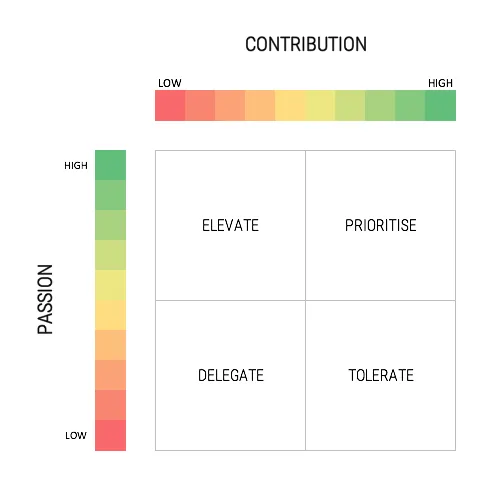
Prioritise
Usually, these activities are the core of your business. You should prioritise these activities to give you the opportunity to deliver more added value, while doing fulfilling work.
Tolerate
These tasks don't challenge you, but you must tolerate them and give your best. Consultants don't have the luxury of doing only those things they are passionate about. Sometimes, we have to get out of our comfort zone. When you realise that some of the activities at the heart of your job are in this section, you may want to change the order and refocus on subjects you are passionate about. This quadrant also highlights the potential for career change.
Elevate
You are passionate about these tasks. They give you renewed energy, but they are not perceived at their true value by your firm. In such controversial scenarios, you may:
- Improve added value. When an activity is really important to you and you know that it represents unquestionable added value for your company, make it known! Take the lead and highlight the value of this project to your colleagues, so that they understand the value of the time you spend working on this topic
- Take a step back. Although some activities may be exciting, it is important to stay on your own turf. Sometimes we all want to share our expertise and take on responsibilities that are not our responsibility. But be careful not to get lost
Delegate
All those activities that waste everyone's time, such as emails, meetings, etc. If you don't have the ability to delegate these tasks to someone, try to reduce the time you spend on them to a minimum. For example, only attend meetings that matter to you. Sort your emails quickly and eliminate anything that doesn't add value.
In conclusion, to get promoted, always give your best. Do what is needed, not just what is asked. Be visible and deliver important pieces of work at a high quality. You have a lot to offer to the world, and if as a result of some very unfortunate chain of events you are pushed out of the firm, don't let it take you down.
Citation
Cite this article
Sridharan, M. A. (2018, December 13). How To Get Promoted As A Consultant?. Think Insights. https://thinkinsights.net/consulting/how-get-promoted-consultant (Accessed [[ACCESS_DATE]])
Sridharan, Mithun A. "How To Get Promoted As A Consultant?." Think Insights, 13 Dec. 2018, https://thinkinsights.net/consulting/how-get-promoted-consultant. Accessed [[ACCESS_DATE]].
Mithun A. Sridharan, "How To Get Promoted As A Consultant?," Think Insights, December 13, 2018, https://thinkinsights.net/consulting/how-get-promoted-consultant. Accessed [[ACCESS_DATE]].
Sridharan, M.A. (2018) 'How To Get Promoted As A Consultant?', Think Insights. Available at: https://thinkinsights.net/consulting/how-get-promoted-consultant (Accessed: [[ACCESS_DATE]]).
M. A. Sridharan, "How To Get Promoted As A Consultant?," Think Insights, 2018. [Online]. Available: https://thinkinsights.net/consulting/how-get-promoted-consultant. [Accessed: [[ACCESS_DATE]]].
Sridharan MA. How To Get Promoted As A Consultant?. Think Insights. Published December 13, 2018. Accessed [[ACCESS_DATE]]. https://thinkinsights.net/consulting/how-get-promoted-consultant
Test Your Knowledge
How To Get Promoted As A Consultant?
Challenge yourself on the concepts from this article and see how well you understood them.
Subscribers get weekly quizzes and insights — subscribe free
Sponsor this article
Partner with Think Insights
Reach 50,000+ business leaders, consultants, and strategists. Feature your brand alongside expert articles on strategy, leadership, and digital transformation.
Become a Sponsor