Tesco Business Model


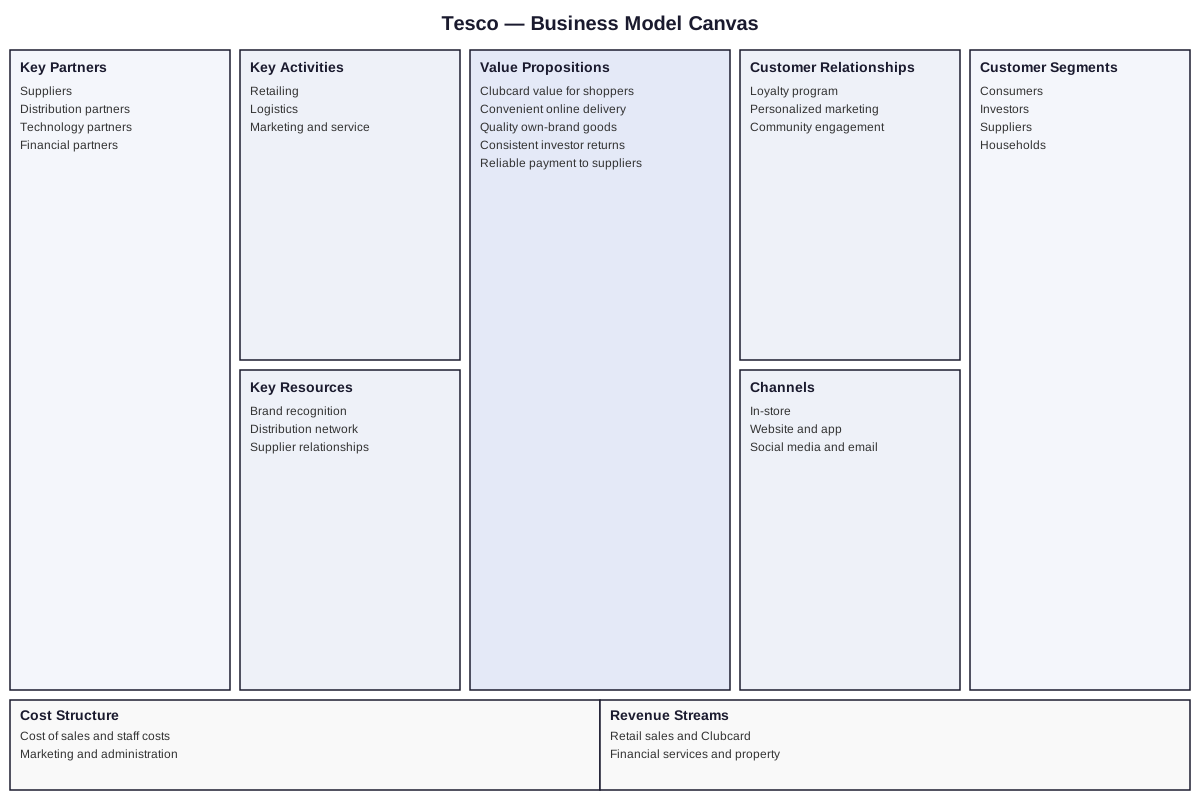
Tesco built the largest grocery business in the United Kingdom by combining store scale, an efficient supplier network and one of retail's most established loyalty programs. The company reported £69.9 billion in revenue for its 2024-25 financial year, up 2.5 percent from the prior year, while its UK market share climbed to 28.3 percent, the highest level since 2016. Tesco's model rests on retail sales across supermarkets, convenience stores and online grocery delivery, supplemented by its Clubcard loyalty scheme, financial services, property income and advertising. This article traces how Tesco evolved from a single market stall into a multinational retailer, examines the mechanics behind its Clubcard data engine and closes with the nine components of its business model canvas.
What is Tesco Clubcard and why is it important?
Clubcard is Tesco's loyalty program that rewards members with points and personalized discounts based on purchase history. It generates substantial revenue for Tesco and produces customer data the company uses to tailor pricing and promotions, a capability discount rivals largely lack.
How does Tesco make money beyond selling groceries?
Beyond retail sales, Tesco earns revenue from Clubcard-related programs, financial services such as insurance and banking, rental income from its property portfolio and advertising space sold across its stores and website. These combined streams supplement thinner margins in core grocery retail.
Why is Tesco's reliance on the UK market considered a weakness?
A large majority of Tesco's revenue comes from the United Kingdom, which makes the company more vulnerable to UK-specific economic downturns, inflation or regulatory changes than competitors with more diversified international operations. This concentration limits Tesco's ability to offset weak domestic performance with growth elsewhere.
From a market stall to a national retailer
Jack Cohen, a Polish immigrant, founded Tesco in 1919 by selling surplus groceries from a market stall in London's East End. The company name combines the initials of tea supplier Thomas Edward Stockwell with the first two letters of Cohen's surname, a detail that reflects the improvised, opportunistic origins of what became Britain's largest retailer.
Cohen opened Tesco's first self-service store in 1924 and its first full supermarket in 1931, embracing a retail format that was still novel in Britain at the time.1 His focus on cost efficiency and private-label products, which let Tesco keep prices below branded competitors, established a pricing discipline that has remained central to the company's identity for a century.
Tesco introduced its Clubcard loyalty program in the 1990s and expanded aggressively through both organic store growth and acquisitions of smaller supermarket chains during the following decades. By the 1990s, the company had become the largest retailer in the United Kingdom, a position it has held for most of the past three decades despite intensifying competition from discount chains.
Tesco's decision to invest in private-label products decades before it became standard industry practice gave the company a structural cost advantage that persisted well into the era of German discount competition
Market leadership and current scale
Tesco's UK market share reached 28.3 percent as of early 2025, its highest level since 2016, driven by what the company has described as a continued focus on value, quality and product availability.2 This share gain came partly at the expense of discount retailers, suggesting Tesco has successfully closed some of the price perception gap that fueled Aldi and Lidl's growth over the previous decade.
Revenue for the 2024-25 financial year reached £69.9 billion, an increase of 2.5 percent over the prior year, while profit in the UK and Ireland rose to £2.74 billion. These figures indicate Tesco has managed to grow both top-line sales and profitability simultaneously, a combination that eluded some UK grocers during periods of high inflation in food costs.
Chief executive Ken Murphy, who joined Tesco in October 2020 after two decades in retail including a leadership role at Boots, has overseen this period of share and profit growth.3 His tenure has coincided with continued investment in digital capabilities and online grocery delivery, areas where Tesco lagged some competitors in the years before his arrival.
The Clubcard data engine
Clubcard operates as more than a simple discount program, functioning as Tesco's primary mechanism for collecting purchase data across tens of millions of members. Points earned on purchases convert into discounts or vouchers, but the underlying data these transactions generate lets Tesco personalize pricing and promotions at an individual customer level rather than relying solely on broad-based advertising.
This personalization capability distinguishes Tesco from discount retailers such as Aldi and Lidl, whose stripped-down store formats and limited product ranges do not generate comparable loyalty data. Tesco has been able to use Clubcard-driven insights to tailor its private-label product development and store assortment decisions, aligning inventory more closely with actual local demand patterns.
Clubcard also generates direct revenue through partnerships with brands that pay for placement in personalized offers, turning the loyalty program into an advertising and data monetization channel that extends well beyond its original function as a customer retention tool.
Diversification into financial services and property
Tesco Bank offers insurance, credit cards and banking products, giving the company a financial services revenue stream that operates somewhat independently of grocery retail margins.4 This diversification reduces Tesco's dependence on food retail profitability alone, though the financial services business remains considerably smaller than the core retail operation.
Tesco's property portfolio, which includes the land and buildings underlying its stores and distribution centers, generates rental income and represents a long-term asset base worth billions of pounds. Owning rather than leasing a substantial share of its retail footprint gives Tesco more control over store locations and format changes than competitors who lease the majority of their real estate.
This property ownership also provides balance sheet flexibility, since Tesco can sell and leaseback properties to raise capital when needed, a tool the company has used periodically to fund other strategic priorities without taking on additional debt.
Competing against discount and premium rivals
Tesco faces distinct competitive pressure from two directions: discount chains like Aldi and Lidl competing on price and premium or specialty grocers competing on product quality and sustainability credentials. Aldi, founded in Germany in 1961, has expanded rapidly in the UK by operating smaller stores with a limited product range, a format that keeps operating costs and prices low.5
Sainsbury's and Morrisons compete more directly with Tesco's full-service supermarket format, each emphasizing different differentiators such as fresh food quality or sustainability commitments. Sainsbury's, for instance, has pledged to reduce carbon emissions by 50 percent by 2030, a positioning that appeals to environmentally conscious shoppers Tesco also targets through its own sustainability initiatives.
Tesco's response to this two-sided competitive pressure has combined price-matching initiatives against discounters with continued investment in own-brand quality and online convenience, an approach designed to defend market share across multiple customer priorities rather than competing on a single dimension.
Supply chain efficiency as a structural advantage
Tesco's in-house buying team negotiates directly with suppliers, letting the company secure favorable terms that support its price-competitive positioning without relying entirely on external distributors. This direct relationship model has been refined over decades and represents an operational capability that newer entrants to UK grocery retail would need years to replicate.
Data analytics increasingly informs Tesco's supply chain decisions, from demand forecasting to inventory placement across its distribution network.6 This capability has become more sophisticated as Tesco has integrated Clubcard purchase data with broader supply chain planning, reducing waste and improving product availability across its store network.
The company's scale advantage compounds these efficiencies, since Tesco's purchasing volume gives it negotiating leverage with suppliers that smaller regional retailers cannot match, reinforcing the low-cost structure that has defined the company since Jack Cohen's earliest days.
Key Partners
Tesco depends on a broad supplier base spanning food producers, manufacturers and private-label partners who supply products across its store network. Distribution partners handle logistics for products moving from suppliers to Tesco's distribution centers and stores, while technology partners support the systems behind online grocery ordering and Clubcard data analytics. Financial partners underpin Tesco Bank's insurance and credit card products and customers themselves function as informal partners through the data and feedback Clubcard generates. These relationships collectively support Tesco's ability to source, distribute and sell products efficiently at scale.
Key Activities
Retailing forms Tesco's core activity, spanning supermarkets, convenience stores and online grocery delivery across the UK and select international markets. Logistics operations move products from suppliers through distribution centers to stores, a process that requires continuous optimization given the perishable nature of much grocery inventory. Marketing and customer service activities support the Clubcard program and broader brand positioning, while technology investment underpins both online shopping infrastructure and in-store systems like self-checkout. Financial services activities round out Tesco's operations through Tesco Bank's insurance and banking products.
Key Resources
Tesco's brand recognition, built over more than a century of UK retail presence, supports customer trust and loyalty at a scale few competitors can match. The company's extensive distribution network and store footprint give it physical reach across the UK, complemented by technology systems that support online ordering and data analytics. A large workforce operates stores, distribution centers and corporate functions, while Tesco's financial resources and property holdings provide balance sheet strength. Strong supplier relationships, cultivated over decades, round out the resource base that underpins the company's cost efficiency.
Value Propositions
Tesco offers consumers value through Clubcard discounts, convenience through online grocery delivery and quality assurance through its own-brand product range. Investors receive consistent financial performance, a track record of dividend payments and exposure to Tesco's continued market share gains in a competitive sector. Suppliers benefit from access to a large customer base, competitive but fair pricing arrangements and reliable, prompt payment terms. Tesco's support for supplier innovation, letting smaller producers pitch new product ideas, extends this value proposition beyond simple transactional purchasing.
Customer Relationships
Tesco's Clubcard loyalty program forms the backbone of its customer relationship strategy, translating purchase history into personalized offers and discounts. Personalized marketing messages, driven by Clubcard data, reach customers through email, app notifications and in-store promotions tailored to individual shopping patterns. Customer service teams handle inquiries and complaints across multiple channels, while community engagement initiatives, including local store sponsorships and charitable partnerships, reinforce Tesco's presence beyond pure transactions.
Channels
Tesco reaches customers primarily through its physical store network, spanning large supermarkets, convenience formats and hypermarkets across the UK. The company's website and mobile app handle online grocery ordering and delivery scheduling, an increasingly important channel since the COVID-19 pandemic accelerated online grocery adoption. Social media and email marketing distribute promotions and Clubcard offers, while print advertising continues to reach segments of the customer base less engaged with digital channels.
Customer Segments
Tesco's primary customer segment consists of consumers purchasing groceries, clothing and household goods across its various store formats and online platform. Investors represent a distinct segment, drawn to Tesco's dividend history and market-leading position within UK grocery retail. Suppliers form a third segment, relying on Tesco's large customer base and reliable payment terms to sustain their own businesses. Each segment receives a distinct value proposition tailored to its specific relationship with the company.
Cost Structure
Cost of sales, covering the products Tesco purchases from suppliers for resale, represents the largest single cost category given the volume of goods moving through its stores. Staff costs form a significant fixed expense across Tesco's large workforce spanning stores, distribution centers and corporate functions. Depreciation and amortization reflect the ongoing investment in store infrastructure, technology systems and distribution facilities. Marketing and advertising costs support Clubcard promotions and broader brand campaigns, while administration costs cover insurance, security and legal expenses across the organization.
Revenue Streams
Retail sales across groceries, clothing and homewares form Tesco's primary revenue stream, generated through its store network and online platform. Clubcard-related revenue, including partner brand payments for personalized offers, supplements core retail income. Financial services revenue from Tesco Bank's insurance, banking and credit card products adds a distinct income stream less tied to grocery margins. Property rental income and other sources, including advertising space sold across stores and the website, round out Tesco's diversified revenue base.
Tesco's dominant UK market share reflects a strategy built around value perception, supply chain efficiency and loyalty data rather than simply outcompeting rivals on price alone. The Clubcard program, with tens of millions of members, gives Tesco a data advantage that discount retailers like Aldi and Lidl cannot easily replicate, since personalized pricing and promotions depend on purchase history most discounters do not collect. Financial services and property income diversify Tesco's revenue beyond retail margins that discount competition continues to compress. The company's heavy reliance on the UK market, which generates the overwhelming majority of its revenue, leaves it exposed to domestic economic conditions in a way that more geographically diversified retailers are not. Continued investment in online grocery and supply chain technology will determine whether Tesco can defend its market-leading position against both traditional supermarket rivals and discount chains.
Citation
Cite this article
Sridharan, M. A. (2024, October 17). Tesco Business Model. Think Insights. https://thinkinsights.net/commercial-excellence/tesco-business-model (Accessed [[ACCESS_DATE]])
Sridharan, Mithun A. "Tesco Business Model." Think Insights, 17 Oct. 2024, https://thinkinsights.net/commercial-excellence/tesco-business-model. Accessed [[ACCESS_DATE]].
Mithun A. Sridharan, "Tesco Business Model," Think Insights, October 17, 2024, https://thinkinsights.net/commercial-excellence/tesco-business-model. Accessed [[ACCESS_DATE]].
Sridharan, M.A. (2024) 'Tesco Business Model', Think Insights. Available at: https://thinkinsights.net/commercial-excellence/tesco-business-model (Accessed: [[ACCESS_DATE]]).
M. A. Sridharan, "Tesco Business Model," Think Insights, 2024. [Online]. Available: https://thinkinsights.net/commercial-excellence/tesco-business-model. [Accessed: [[ACCESS_DATE]]].
Sridharan MA. Tesco Business Model. Think Insights. Published October 17, 2024. Accessed [[ACCESS_DATE]]. https://thinkinsights.net/commercial-excellence/tesco-business-model
Test Your Knowledge
Tesco Business Model
Challenge yourself on the concepts from this article and see how well you understood them.
Subscribers get weekly quizzes and insights — subscribe free
Sponsor this article
Partner with Think Insights
Reach 50,000+ business leaders, consultants, and strategists. Feature your brand alongside expert articles on strategy, leadership, and digital transformation.
Become a Sponsor