Digital Transformation Pyramid


Companies often treat digital transformation as a technology purchase rather than a business change. Leaders should apply the Digital Transformation Pyramid, addressing strategy, execution and technology together rather than in isolation. An effective program must embrace at least two of these three levels, since any single level alone cannot transform a company. The immediate decision is this: before approving your next digital initiative, confirm it connects a specific strategic objective to a concrete execution change, not merely a new technology purchase.
Why does implementing new software rarely count as digital transformation?
New IT systems only qualify as transformation when connected to a broader operating model change or go-to-market shift; a standalone tool implementation without that connection remains a technology project, not transformation.
What separates the Digital Transformation Pyramid from thinking of transformation as purely technical?
The pyramid treats technology as an enabler sitting beneath strategy and execution, not the core of transformation itself, since Patrick Turchi's framework insists there is no such thing as a purely digital strategy, only business strategy in a digital-enriched environment.
Can a company skip the technology layer and still transform successfully?
No single layer works alone, but the framework requires embracing at least two of the three levels, meaning execution paired with strategy can drive meaningful change even before every technology piece falls into place.
Patrick Turchi, a management consultant with extensive experience in corporate strategy, organization and transformation, introduced the Digital Transformation Pyramid in 2018.1 Turchi built the framework from his own consulting experience, aiming to clarify a topic he considered one of the most discussed yet least clearly defined subjects in corporate strategy at the time.
Turchi developed the pyramid partly in conversation with existing thinking on the subject. Alessandro Braga, chief information officer at Talent Garden, had previously identified six pillars of digital transformation split between internal factors, including people, process and technology, and external factors, including customer, relationship and product or service offerings.2 Researchers Peter Weill and Stephanie Woerner at the MIT Sloan Center for Information Systems Research had separately identified customer experience and operational efficiency as the two key dimensions for assessing an organization’s digital readiness.
Turchi’s framework responds to a consistent theme running through this broader body of work: digital transformation is not fundamentally about technology, but rather about a new way of conducting business. Management scholar George Westerman captured this idea directly, stating that when it comes to digital transformation, digital is not the answer; transformation is. The pyramid exists to translate this insight into a structure executives can apply directly, rather than leaving it as an abstract observation.
The Three Levels of the Pyramid
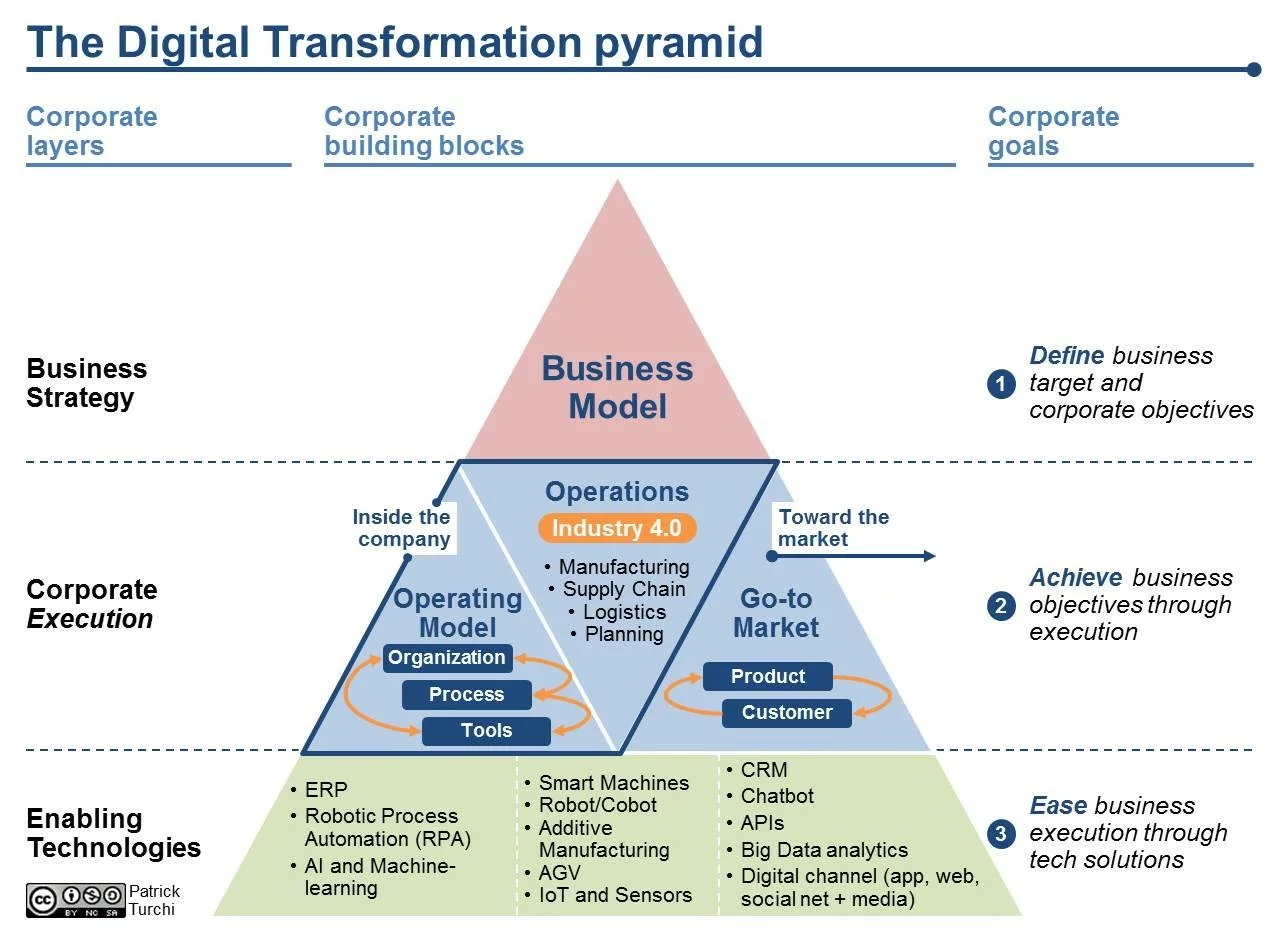
Turchi’s framework organizes digital transformation across three levels: strategy, execution and technology. These three levels sit in a pyramid structure specifically because each level depends on and shapes the others, rather than functioning as independent, separable initiatives a company could pursue in isolation. A program addressing only one level in isolation risks becoming either a theoretical exercise confined to board presentations or a narrow technology rollout disconnected from any broader business change.
An effective digital transformation program must embrace at least two of these three levels, and ideally all three over the long term, according to Turchi’s framework. This requirement rules out two common failure patterns directly. Defining a new digital business model without executing it through a corresponding go-to-market approach produces a theoretical exercise that changes nothing about how the business actually performs. Conversely, implementing a new IT system such as an ERP or CRM platform, or launching a standalone e-commerce site, does not itself constitute digital transformation unless that implementation connects to a broader operating model change or market approach.
Each level of the pyramid exerts strong influence on, and actually helps define, the other two levels.3 This interdependence means executives cannot simply delegate one layer to a specialized team and expect coherent results. A strategy team defining a new business model needs early visibility into execution constraints and technological possibilities, just as a technology team implementing new systems needs clear strategic direction to avoid building capability that no execution plan will ever use.
Layer One: Strategy and Business Model
The strategy layer sits at the top of the pyramid, and Turchi treats this placement as a deliberate statement about priority. He argues explicitly that there is no such thing as a separate digital strategy, only business strategy operating within a digital-enriched environment. This framing matters because it prevents organizations from treating digital initiatives as a parallel track running alongside core business strategy rather than as an integrated part of it.
At this level, corporations must evaluate the opportunities, impacts and potential threats associated with technology-enabled business models. Turchi points to several specific patterns worth evaluating directly, including platform business and marketplace models, the evolution from ownership toward access through pay-per-use arrangements, value-added services delivered through digital technology, and entirely new data-based products and services. These patterns represent genuine business model shifts, not merely digital versions of existing offerings.
Executives working at this layer should resist the temptation to bolt digital features onto an unchanged business model and call the result a strategy. The layer demands asking whether digital technology changes what the company actually sells, how it captures value, or who its competitors are, rather than only asking how existing operations might run more efficiently with new tools.
Layer Two: Execution
The execution layer translates strategic intent into operational reality, and Turchi structures it around three specific building blocks: the corporate operating model, the operating model of operations, and the go-to-market approach. He frames execution’s importance directly, noting that however elegant a strategy might be, results still require regular scrutiny, since strategy alone changes nothing without disciplined execution behind it.
Execution works in two directions, reaching both inside the company and outside toward the markets it serves. Internally, the operating model defines organization, procedure and tools, shaping the structure of the corporate and how it functions day to day. The operations layer constitutes how the corporation actually produces the products and services it intends to push into the market, covering the operational mechanics that turn strategic intent into delivered output.
Externally, the go-to-market approach defines product and customer considerations together, covering elements such as pricing, distribution channels, promotional approach and the digital-enabled value proposition offered to customers. Turchi emphasizes that digital contexts complicate even basic definitions at this layer. He poses a pointed example: in a car-sharing platform, what exactly constitutes the product? Is it the vehicle access itself, the arrival at a destination, or the time saved? This question shapes pricing, positioning and the entire value proposition a company communicates to customers.
Layer Three: Technology
Technology sits at the base of the pyramid, and Turchi is explicit that this position reflects technology’s role as an enabler rather than the core of transformation itself. Technology serves and supports the realization of business targets through the execution blocks above it, rather than driving transformation independently. This placement corrects a common executive misconception that acquiring advanced technology automatically produces transformation.
Technology enables evolution within the operating model, within operations through approaches like Industry 4.0, and within the realization of go-to-market strategy. At the same time, Turchi notes that technology also functions as a driver of change across every level of the pyramid, since new technological capabilities can reveal business model opportunities or execution possibilities that strategy and execution teams had not considered. Identifying technology’s impact at each level, he argues, constitutes a genuinely strategic corporate capability, not merely a technical one confined to the IT function.
This dual role, technology as both enabler and driver, requires executives to maintain active dialogue between technology teams and the layers above them. A technology function that operates in isolation, simply fulfilling specification requests, misses opportunities to surface emerging capabilities that could reshape strategic thinking. Equally, a strategy function that ignores technological developments risks building plans on assumptions technology has already made obsolete.
Digital Transformation as an Ongoing People Journey
Turchi closes his framework with a point easily lost amid discussion of strategic and technical layers: digital transformation is fundamentally about people, not technology. He frames transformation as a journey rather than a destination, requiring constant review and reassessment rather than a single implementation followed by completion. The organization’s acceptance of new technologies, procedures and structures requires ongoing monitoring, with quick adjustment whenever that acceptance falls short.
Change management, in Turchi’s view, remains essential for exactly this reason. Genuine openness toward technology and innovation must exist throughout the organization, particularly within top management, for a transformation initiative to succeed. Technology functions may own the technical knowledge the transformation requires, but a broader understanding of technology’s implications across every company function ultimately determines whether the initiative succeeds or stalls.
The Digital Transformation Pyramid connects strategy, execution and technology across five building blocks: business model, operating model, operations, go-to-market and technology. Effective programs address at least two levels together, treating technology as an enabler rather than the transformation's core.
Test Your Knowledge
Digital Transformation Pyramid Quiz
Challenge yourself on the concepts from this article and see how well you understood them.
Subscribers get weekly quizzes and insights — subscribe free
Partner with Think Insights
Reach 50,000+ business leaders, consultants, and strategists. Feature your brand alongside expert articles on strategy, leadership, and digital transformation.
