Infrastructure Shapes Digital Business Models


Digital business models rest on infrastructure most customers never see: servers, data centers, networks and the software connecting them. Companies that treat these systems as background utilities often discover the cost only after a checkout page stalls or a service goes dark during peak demand. Companies that treat infrastructure as a design choice convert more visitors, scale into new markets faster and absorb shocks that would otherwise show up as lost revenue. This article traces seven ways infrastructure decisions shape outcomes for platforms, marketplaces and software companies: customer experience, scalable growth, value delivery, operational risk, long-term cost, innovation capacity and competitive differentiation. It closes with a business model breakdown of Equinix, a global operator of data center and interconnection facilities that turns infrastructure itself into its product.
What is infrastructure in a digital business model?
Infrastructure refers to the servers, networks, data centers and software systems that let a digital product operate, deliver value and reach customers reliably. It sits behind the interface customers see, but it determines whether that interface loads quickly, stays available and handles demand without breaking.
How does infrastructure affect customer experience?
Slow, unreliable infrastructure causes customers to abandon transactions and switch to competitors, while fast, stable infrastructure keeps them engaged through the entire purchase process. The effect compounds over time, since customers who experience friction once are less likely to return for a second try.
Why do companies treat infrastructure as a competitive advantage?
Companies with faster, more reliable infrastructure retain customers more easily and scale into new markets without rebuilding core systems, an edge competitors struggle to match quickly. Infrastructure that was built to flex also lets a business test new ideas and enter new markets faster than rivals still working around rigid systems.
Customer experience runs on speed
Every digital business model depends on a customer's patience, which is short and getting shorter. When a checkout page stalls for even a few seconds, some share of visitors leaves before finishing the purchase and many never come back to try again. A joint study by Google and Deloitte found that a 0.1-second improvement in mobile load speed raised retail conversions by 8.4 percent and lifted average order value by 9.2 percent.1 Travel sites saw an even larger gain, with the same tenth-of-a-second improvement driving a 10.1 percent rise in bookings.
A slow platform quietly discounts the product without anyone approving the markdown
Executives who file that finding under marketing miss the point. Load speed is set by server placement, network routing, caching and the code running on top of them, which makes it an infrastructure outcome first. Businesses that route customer traffic through data centers close to major population centers, rather than a single distant server farm, tend to keep load times low enough to protect that revenue.
Growth depends on infrastructure that scales
Scalability separates a digital business model that survives a viral moment from one that collapses under it. As a company adds users, transactions and data, its infrastructure needs to expand without a proportional jump in cost or a drop in performance. Global spending on data center systems is projected to exceed 788 billion dollars in 2026, a sign of how much capital businesses now commit to infrastructure built to absorb this kind of growth.2 Dedicated servers and elastic cloud capacity let businesses add resources incrementally, rather than rebuilding their technology stack every time demand jumps.
Companies that plan for scale from the outset avoid a costly pattern common among their peers: rebuilding core systems mid-growth while competitors already serving the market keep moving. Scalable infrastructure turns growth from a threat into routine operations.
Value creation, delivery and capture all run through infrastructure
A business model earns money by creating value, delivering it to customers and capturing a share of what it generates and infrastructure touches all three steps. On the creation side, reliable computing power and data pipelines let engineering teams build products that work as advertised, not features that only work in a demo. On the delivery side, content delivery networks, application programming interfaces [APIs] and payment systems determine whether that value actually reaches the customer without friction.
On the capture side, efficient infrastructure keeps operating costs from eating into margins, which is why profitable digital business models rarely tolerate wasteful backend systems. Weak infrastructure at any one of these stages can undo strong work at the other two, since a good product delivered through a broken channel still produces a poor outcome for the customer.
Containing operational and security risk
Downtime and security incidents translate directly into lost revenue and damaged trust and digital businesses have less room to absorb either than most executives assume. A single outage during a peak sales period can erase the marketing spend that drove customers there in the first place. The global average cost of a data breach reached 4.44 million dollars in 2025, though the figure climbs above 10 million dollars for organizations based in the United States.3
Infrastructure built with redundancy, monitoring and layered security controls reduces both the frequency and the severity of these events. Businesses that invest in this kind of resilience are not paying for insurance against a hypothetical, they are protecting revenue that is already flowing through their systems every day.
The economics of infrastructure change over time
Infrastructure investment looks expensive the moment it is made and cheap several years later, which is exactly why many companies underfund it. Upgrading servers, adopting managed cloud services or redesigning a data architecture carries an upfront cost that shows up immediately on a budget line. The savings, by contrast, arrive gradually: fewer emergency fixes, less staff time spent firefighting and fewer customers lost to slow or unreliable service.
Organizations that modernize core infrastructure report measurable gains in cost, productivity and operating flexibility compared with those still running on legacy systems.4 Treating infrastructure spending as a multi-year investment, rather than a cost to minimize this quarter, tends to produce a lower total bill once the hidden costs are counted.
Flexibility is what makes innovation possible
Markets shift and a business model that cannot adjust its technology quickly enough loses ground to one that can. Launching a new feature, entering a new geography or testing a new pricing model all depend on infrastructure that does not require months of rework to support them. Deloitte's 2026 technology trends research points to enterprises replacing fragmented systems with unified, adaptive foundations specifically so new ideas can move from concept to production faster.5
Rigid infrastructure does the opposite: it turns every new idea into a technical project before it can become a market test. Flexible infrastructure keeps that gap short, which matters more in markets where customer preferences shift every quarter rather than every decade.
Infrastructure has become a competitive differentiator
Two companies can sell a similar product and still end up with very different market positions and infrastructure is often the hidden reason why. Faster, more reliable platforms earn repeat business even when the core offering looks identical to a competitor's, because customers experience the difference every time they use the product. Equinix, a global operator of data center and interconnection facilities, has built its entire business around this idea by selling infrastructure itself as the product rather than treating it as a supporting function.
The company reported 9.2 billion dollars in revenue for 2025, with interconnection services, the fees it charges to link customers' networks directly to each other, growing faster than the rest of its business.6 That growth illustrates the broader point: when infrastructure works well, it becomes invisible to the customer and when it works exceptionally well, it becomes the reason a customer chooses one company over another.
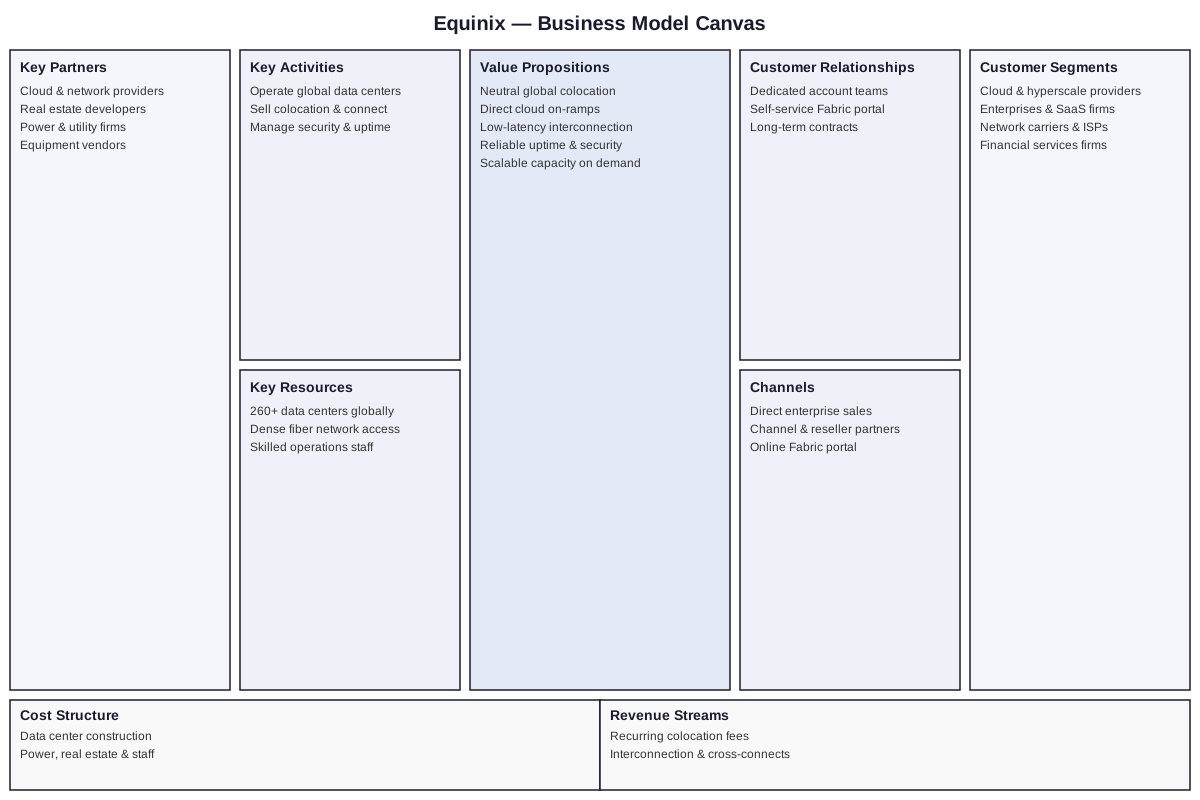
Key Partners
Equinix depends on cloud providers, network carriers and internet service providers that establish points of presence inside its facilities, since their presence makes the ecosystem valuable to everyone else there. Real estate developers and construction firms supply the sites and buildings Equinix converts into data centers. Power utilities and renewable energy suppliers keep facilities running and support the company's sustainability commitments. Equipment vendors supplying servers, cooling and cabling round out the partner base that keeps facilities operational.
Key Activities
Equinix's core activity is building and operating International Business Exchange [IBX] data centers, physical facilities where customers install their own computing equipment. Alongside construction, the company sells colocation space, manages interconnection between tenants and continuously expands capacity to meet demand. Round-the-clock monitoring, security operations and power management keep facilities running at the reliability level customers expect. Sales and account management activities convert available capacity into signed, recurring contracts.
Key Resources
The company's core resource is its footprint of data centers across dozens of countries, each a physical asset that took years to permit and build. Dense fiber connectivity between and within these facilities lets customers reach clouds, partners and each other with minimal delay. Equinix's ecosystem density, the sheer number of networks and cloud providers already present in its buildings, is itself a resource competitors cannot quickly replicate. Skilled operations and engineering staff keep the physical infrastructure running at the reliability level customers pay for.
Value Propositions
Equinix offers vendor-neutral colocation, letting customers place equipment in its facilities without being tied to any single cloud or network provider. Direct on-ramps to major cloud platforms let customers connect privately rather than over the public internet, improving both speed and security. Low-latency interconnection between tenants supports use cases, such as financial trading and real-time data exchange, that cannot tolerate delay. Reliable uptime, backed by redundant power and cooling, gives customers a dependable foundation for products they cannot afford to have go offline.
Customer Relationships
Large enterprise customers typically work with dedicated account teams who manage capacity planning, contract renewals and technical support. Equinix Fabric, a self-service digital portal, lets customers provision new connections without waiting on a sales cycle. Contracts tend to run for multiple years, reflecting that customers are placing physical equipment that is costly to move once installed. This combination of high-touch account management and self-service tools serves both large and smaller customers.
Channels
Direct enterprise sales teams handle the largest accounts and custom deployments, since these deals involve significant capacity commitments and technical requirements. Channel partners and resellers extend Equinix's reach into markets and customer segments its direct sales force covers less efficiently. The Equinix Fabric portal serves as a digital channel where existing customers add connections or capacity on their own. Industry events and partner ecosystems also generate leads, particularly among cloud and network providers evaluating where to establish new points of presence.
Customer Segments
Cloud and hyperscale providers make up a core segment, using Equinix facilities to place infrastructure close to enterprise customers and other networks. Enterprises and software companies rent space to run their own equipment or connect privately to cloud providers. Network carriers and internet service providers use Equinix facilities as interconnection points with other networks. Financial services firms represent a specialized segment that values the low-latency connections Equinix facilities provide for trading systems.
Cost Structure
Constructing new data centers requires substantial upfront capital, covering land, buildings, power infrastructure and cooling systems. Ongoing power consumption represents one of the largest recurring costs, given how much electricity dense computing equipment draws. Real estate leases, facility maintenance and a global operations workforce add further recurring expense. Equinix also spends on acquisitions, having grown its footprint partly by purchasing existing data center operators in new markets.
Revenue Streams
Recurring colocation fees, charged for the cabinet space and power customers use inside Equinix facilities, form the largest share of revenue. Interconnection fees, charged for the physical and virtual cross-connects that link customers' networks together, represent the fastest-growing and highest-margin revenue stream. Managed infrastructure services, which handle equipment on behalf of customers who prefer not to manage it themselves, add a smaller additional stream. Together these streams reward Equinix for capacity utilized rather than one-time transactions, giving the business a largely recurring revenue base.
Infrastructure is no longer a back-office concern separate from strategy, it is one of the mechanisms strategy runs on. The seven patterns covered here, from load times to security to scalability, all point to the same conclusion: systems that customers never see still determine what customers experience. Equinix shows what happens when a company builds its entire business model around that idea, turning data centers and interconnection into a product other businesses depend on. For most companies, the lesson is narrower but still practical. Infrastructure decisions made early, around scalability, redundancy and flexibility, tend to compound into lower costs and steadier growth later. Businesses that treat infrastructure as a strategic input, not just an operating expense, put themselves in a stronger position to grow without rebuilding under pressure.
Citation
Cite this article
Sridharan, M. A. (2021, March 16). Infrastructure Shapes Digital Business Models. Think Insights. https://thinkinsights.net/digital-transformation/infrastructure-shapes-digital-business-models (Accessed [[ACCESS_DATE]])
Sridharan, Mithun A. "Infrastructure Shapes Digital Business Models." Think Insights, 16 Mar. 2021, https://thinkinsights.net/digital-transformation/infrastructure-shapes-digital-business-models. Accessed [[ACCESS_DATE]].
Mithun A. Sridharan, "Infrastructure Shapes Digital Business Models," Think Insights, March 16, 2021, https://thinkinsights.net/digital-transformation/infrastructure-shapes-digital-business-models. Accessed [[ACCESS_DATE]].
Sridharan, M.A. (2021) 'Infrastructure Shapes Digital Business Models', Think Insights. Available at: https://thinkinsights.net/digital-transformation/infrastructure-shapes-digital-business-models (Accessed: [[ACCESS_DATE]]).
M. A. Sridharan, "Infrastructure Shapes Digital Business Models," Think Insights, 2021. [Online]. Available: https://thinkinsights.net/digital-transformation/infrastructure-shapes-digital-business-models. [Accessed: [[ACCESS_DATE]]].
Sridharan MA. Infrastructure Shapes Digital Business Models. Think Insights. Published March 16, 2021. Accessed [[ACCESS_DATE]]. https://thinkinsights.net/digital-transformation/infrastructure-shapes-digital-business-models
Test Your Knowledge
Infrastructure Shapes Digital Business Models
Challenge yourself on the concepts from this article and see how well you understood them.
Subscribers get weekly quizzes and insights — subscribe free
Sponsor this article
Partner with Think Insights
Reach 50,000+ business leaders, consultants, and strategists. Feature your brand alongside expert articles on strategy, leadership, and digital transformation.
Become a Sponsor