The Infrastructure of Agility


Corporate scalability once depended on capital: how many buildings, licenses and local staff a company could afford before entering a new market. That equation has flipped. Cloud infrastructure, application programming interfaces [APIs] and identity-based security now let a business project a presence anywhere without owning a single square foot there. Location has shifted from a fixed cost to a variable one and the Business Model Canvas blocks that once meant physical assets and storefronts, Key Resources and Channels, now describe software, data and digital ecosystems instead. This piece traces that shift across the canvas, from zero trust security to human-AI collaboration to sustainability reporting and shows how Cloudflare, the internet infrastructure company, turns the pattern into a working business model.
What does digital decentralization mean for a business model?
Digital decentralization replaces fixed physical assets, offices, servers, local staff, with distributed digital infrastructure a company can scale up or down on demand. Cloud platforms, APIs and virtual identity tools let a business operate in a new market without renting space or hiring local administrators first. This converts many fixed costs into variable ones tied directly to usage.
How does the Business Model Canvas change under this shift?
Two blocks change the most. Key Resources shifts from equipment and property toward proprietary data, algorithms and network capacity. Channels shifts from physical storefronts and call centers toward APIs, self-service portals and embedded integrations that let customers consume a service without ever speaking to a salesperson.
Why does cybersecurity belong in a discussion of business models rather than IT?
A data breach damages the Customer Relationships block directly, not only the technology stack. Zero trust security, which verifies every user and device rather than trusting anyone inside a network perimeter, protects the trust an entire revenue model depends on. Losing that trust can end a customer relationship as quickly as a product failure can.
From Fixed Assets to Variable Infrastructure
A generation ago, a company entering a new market needed a lease, a phone line and a local bank account before it sold a single unit. Cloud computing and application programming interfaces [APIs] have replaced that checklist with a subscription and a login. A business can now stand up a local presence, a phone number, a payment method, a data residency setting, without owning a single asset in that country. This shift turns geography from a fixed cost decision into a variable one that scales with actual demand. Enterprise agility now depends less on how many offices a company operates and more on how well its digital infrastructure adapts to new markets and workloads.1
Rewiring the Business Model Canvas
The Business Model Canvas has nine blocks, but two have changed meaning more than the rest. Key Resources once meant factories, fleets and real estate; today it more often means a proprietary algorithm, a labeled dataset or a slice of compute capacity rented by the second. Channels once meant storefronts, call centers and print catalogs; today it means an API, a self-service dashboard or an embedded integration inside a partner's software. Platform-based competitors are winning by controlling these digital versions of the two blocks rather than by owning more physical infrastructure than their rivals.2
A channel is no longer a place customers visit. It is a connection they never see
A company that treats its API catalog as a product, not a technical afterthought, is already ahead of most competitors still selling through a website alone.
The Rise of the Invisible Enterprise
Some of the fastest-growing companies today generate substantial revenue while keeping a small physical footprint of offices or warehouses. That does not mean they lack scale; it means their scale lives in software and networks rather than square footage. A subscription-based service can pivot to usage-based pricing by changing a billing rule, not by renovating a building or retraining a nationwide sales force. Distributed hiring extends the same logic to people and companies increasingly tap a global talent pool through remote roles. The World Economic Forum projects remote digital jobs will grow past 90 million by 2030 as employers look beyond their home city for skilled workers.3
Zero Trust as a Growth Engine
Security decisions used to sit entirely with the chief information officer. Today they sit inside the business model itself, because a breach damages the Customer Relationships block as directly as it damages a server. Zero trust architecture, a security approach that verifies every user and device rather than assuming anyone inside the network perimeter is safe, has become the standard framework for this problem. The National Institute of Standards and Technology [NIST] formalized the approach in Special Publication 800-207, which shifts defense away from static network boundaries and toward continuous verification of identity and device posture.4
Adopting this model lets a company onboard remote employees, contractors and partner organizations without expanding its physical security perimeter at all.
Keeping Humans in the Loop
Automation handles the routine well: reconciling invoices, routing support tickets, flagging anomalies in a supply chain. It handles judgment calls poorly. Artificial Intelligence [AI] can process a customer's transaction history in milliseconds, but it cannot read the frustration in a phone call the way a trained account manager can. Research from the Massachusetts Institute of Technology [MIT] Sloan School of Management found that AI is more likely to complement human workers than to displace them, particularly in roles that require empathy, judgment or creativity.5
The advantage now sits with companies that let software absorb repetitive work and let people own the judgment calls
A business model built entirely on software is easy for a competitor to copy; one that pairs software with skilled judgment is not.
Folding Sustainability into the Ledger
Environmental, social and governance [ESG] factors used to live in a separate corporate responsibility report, disconnected from the Cost Structure and Value Propositions blocks of the business model. Global standard-setters are closing that gap. The International Sustainability Standards Board [ISSB] issued its first two disclosure standards in June 2023, requiring companies to report sustainability risks and climate impact with the same rigor applied to financial statements.6
A company that replaces international flights with high-fidelity video collaboration, or swaps physical SIM cards for embedded virtual ones, cuts both its carbon footprint and its cost structure at once. That overlap between lower emissions and lower spending is why sustainability now sits inside the business model conversation, not beside it.
Cloudflare as the Model in Motion
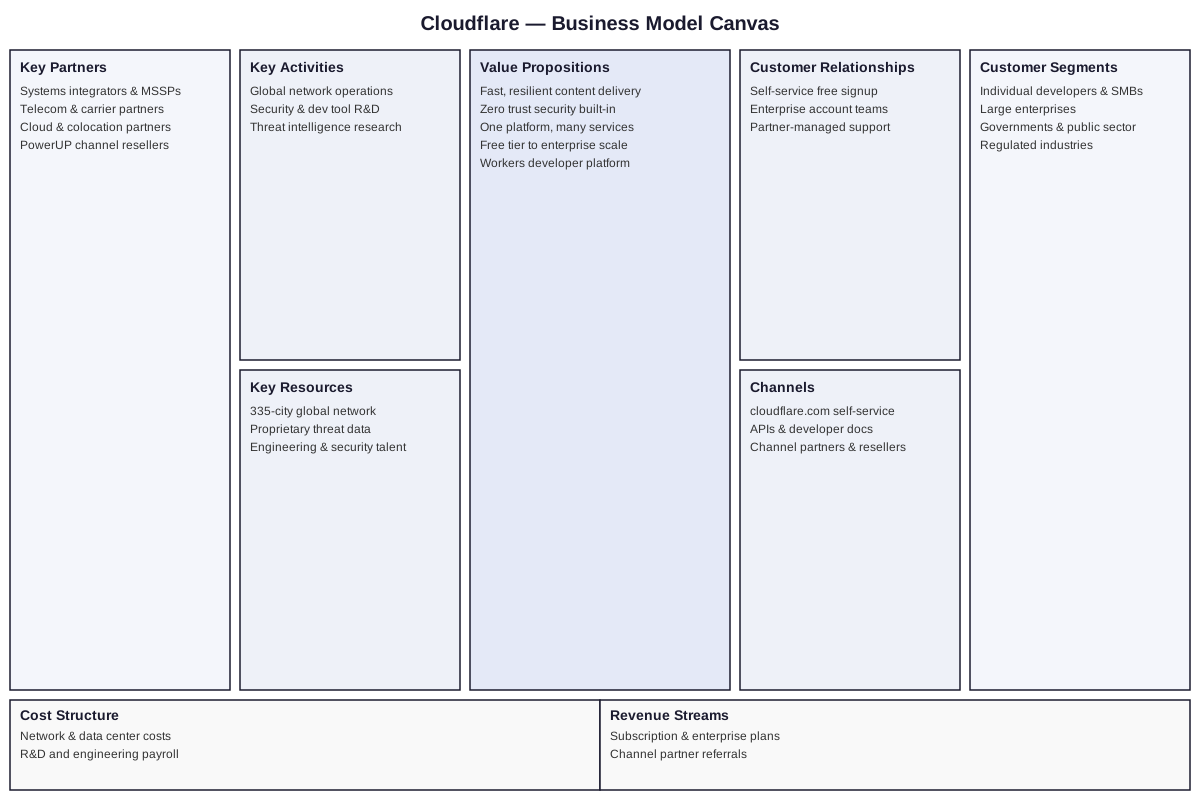
Cloudflare, the U.S. internet infrastructure company, illustrates each of these shifts inside a single, publicly documented business model. Its key resource is not a headquarters building but a global network spanning hundreds of cities, most of it running as software on shared hardware rather than dedicated equipment per customer. Its channels are largely digital: self-service signup, an API and a partner ecosystem, rather than a direct sales floor. The sections below walk through Cloudflare's canvas block by block, showing how a decentralized, security-first infrastructure model turns into a specific set of partners, activities, resources and revenue streams.
Key Partners
Cloudflare relies on systems integrators and managed security service providers to close complex enterprise deals that need custom deployment. Telecom and carrier partners extend its network reach into regions where local peering matters most. Cloud and colocation providers host portions of its infrastructure alongside company-owned hardware. The PowerUP partner program, launched in 2024, gives resellers and consultants a structured path to revenue and channel partners already contribute close to a quarter of total revenue.
Key Activities
Cloudflare's core activity is operating a global network that routes, filters and accelerates internet traffic in real time. Engineering teams continuously build and refine security products, developer tools and the Workers platform that runs code at the network edge. A dedicated threat intelligence function studies attack patterns across the network to strengthen defenses for every customer at once. Research and development spending stays high to keep the platform ahead of new attack methods.
Key Resources
The company's defining resource is its global network, spanning hundreds of cities and built mostly on shared, software-defined infrastructure rather than dedicated hardware per customer. Proprietary threat data, gathered from traffic across that network, feeds detection models no single customer could build alone. Engineering and security talent turns that raw visibility into shippable products and the brand itself, closely tied to reliability, functions as a resource in enterprise sales.
Value Propositions
Cloudflare's value proposition centers on speed and resilience: content and applications reach users faster because traffic rarely has to travel far from an edge location. Zero trust security comes built into the platform rather than added afterward. Customers get one platform for content delivery, security and networking instead of stitching together multiple vendors. Pricing scales from a free tier for individual developers to enterprise contracts and the Workers developer platform lets customers build directly on the network.
Customer Relationships
Most Cloudflare customers start through self-service signup, never speaking to a salesperson before their first deployment. Enterprise accounts get dedicated account teams and technical support once contract size and complexity justify it. Partners increasingly own the relationship for mid-market and regulated customers, managing implementation and support on Cloudflare's behalf under the PowerUP program.
Channels
The primary channel is Cloudflare's own website, where anyone can sign up for a free plan in minutes. APIs and developer documentation form a second channel, letting engineers integrate Cloudflare services directly into their own applications without human contact. Channel partners, resellers and systems integrators form a growing third channel, especially for enterprise and regulated customers who want a managed relationship.
Customer Segments
Cloudflare serves individual developers and small businesses through its free and low-cost plans, a segment that seeds future enterprise growth. Large enterprises make up its highest-value segment, paying for custom security and performance guarantees. Governments and public sector bodies use the platform for resilience against large-scale attacks. Regulated industries, including finance and health care, adopt it for compliance-aligned data handling.
Cost Structure
Operating a global network is capital-intensive: data center capacity, bandwidth and hardware refresh cycles make up a significant share of Cloudflare's costs. Research and development, engineering and sales payroll form the other major cost pool, reflecting a company that competes on product breadth and technical depth rather than physical footprint. Costs scale with network traffic more than with any single customer contract.
Revenue Streams
Subscription plans generate the bulk of Cloudflare's revenue, priced by feature tier and usage rather than by seat. Enterprise contracts add custom pricing for large-scale deployments with negotiated service levels. Channel partner referrals and reselling arrangements now contribute close to a quarter of revenue and continue to grow. Developer platform usage, including Workers and data services, is an emerging revenue line tied directly to usage volume.
- 1Enterprise Agility Depends On API Infrastructure
- 2Platform Competition Rewards Owning The Digital Layer
- 3Remote Digital Jobs Are Reshaping Global Talent Access
- 4NIST Defines Zero Trust Architecture Standards
- 5MIT Sloan Finds AI Complements Rather Than Replaces Workers
- 6ISSB Sets Global Sustainability Disclosure Standards
Business model scalability no longer means predicting a stable future and building fixed assets to match it. It means designing for change: infrastructure that expands and contracts with demand, identity systems that secure a workforce with no single office and value propositions that can pivot from subscription to usage-based pricing within a product cycle. Cloudflare's canvas shows what this looks like in practice, a company whose key resource is a global network rather than a warehouse and whose channels are developer APIs rather than storefronts. The business leaders who benefit most from this shift treat digital infrastructure as a strategic asset, not a background utility. Resilience, not permanence, is now the measure of a well-built business model.
Citation
Cite this article
Sridharan, M. A. (2021, January 2). The Infrastructure of Agility. Think Insights. https://thinkinsights.net/digital-transformation/infrastructure-agility (Accessed [[ACCESS_DATE]])
Sridharan, Mithun A. "The Infrastructure of Agility." Think Insights, 2 Jan. 2021, https://thinkinsights.net/digital-transformation/infrastructure-agility. Accessed [[ACCESS_DATE]].
Mithun A. Sridharan, "The Infrastructure of Agility," Think Insights, January 2, 2021, https://thinkinsights.net/digital-transformation/infrastructure-agility. Accessed [[ACCESS_DATE]].
Sridharan, M.A. (2021) 'The Infrastructure of Agility', Think Insights. Available at: https://thinkinsights.net/digital-transformation/infrastructure-agility (Accessed: [[ACCESS_DATE]]).
M. A. Sridharan, "The Infrastructure of Agility," Think Insights, 2021. [Online]. Available: https://thinkinsights.net/digital-transformation/infrastructure-agility. [Accessed: [[ACCESS_DATE]]].
Sridharan MA. The Infrastructure of Agility. Think Insights. Published January 2, 2021. Accessed [[ACCESS_DATE]]. https://thinkinsights.net/digital-transformation/infrastructure-agility
Test Your Knowledge
The Infrastructure of Agility
Challenge yourself on the concepts from this article and see how well you understood them.
Subscribers get weekly quizzes and insights — subscribe free
Sponsor this article
Partner with Think Insights
Reach 50,000+ business leaders, consultants, and strategists. Feature your brand alongside expert articles on strategy, leadership, and digital transformation.
Become a Sponsor