Industry Analysis: Artificial Intelligence


Capital should follow infrastructure and distribution, not model novelty. Foundation model labs generate the headlines, but chipmakers and cloud infrastructure providers capture the most durable margin, because compute scarcity outlasts any single model's advantage. The Artificial Intelligence industry, spanning foundation model labs, compute providers, MLOps tooling and applied vendors, now exceeds $500 billion in annual revenue and grows faster than nearly any other technology segment, making it strategically unavoidable for boards across every sector. Bargaining power is shifting toward enterprise buyers, who multi-home across model providers and negotiate hard on usage-based pricing and toward the semiconductor and power layer, where scarcity remains structural. Executives should treat frontier model access as a commodity input to secure on favorable terms, while directing proprietary investment toward data assets, workflow integration and applied products that competitors cannot easily replicate.
Is Artificial Intelligence attractive for new entrants?
It depends entirely on where in the value chain an entrant targets. Frontier foundation model training has become prohibitively capital intensive, with leading labs spending tens of billions of dollars annually on compute alone, effectively closing that segment to all but the best-funded players. Applied Artificial Intelligence, vertical software built on top of existing models, remains genuinely attractive, because the capital barrier is low and differentiation comes from data, workflow integration and domain expertise rather than model ownership.
Which parts of the value chain are most profitable?
Semiconductor design and advanced chip manufacturing currently capture the highest and most durable margins, because supply remains structurally constrained relative to demand. Cloud infrastructure providers renting compute capacity also earn strong margins, particularly where they combine proprietary chips with distribution reach. Foundation model labs earn substantial revenue but thinner margins after compute costs, since competitive pressure forces continuous price cuts on application programming interface access.
How is technology changing this industry?
The shift from single-purpose predictive models toward general-purpose foundation models has restructured competitive dynamics, allowing one underlying model to serve thousands of applications rather than requiring bespoke development for each use case. Inference costs have fallen sharply as model efficiency techniques mature, shifting spending from training toward running models in production. Agentic systems capable of multi-step reasoning and tool use represent the next technology shift, moving value from single-response accuracy toward reliable task completion.
What capabilities are table stakes vs differentiators?
Access to a capable foundation model, whether built in-house or licensed through an application programming interface, has become table stakes, available to any company with a credit card and engineering time. True differentiators lie in proprietary data that improves model performance for a specific task, deep integration into a customer's existing workflow that raises switching costs and the operational discipline to manage model reliability, cost and safety at production scale.
How should investors and consultants evaluate opportunities here?
Evaluate opportunities by asking where a company sits relative to compute scarcity and data ownership, rather than by how impressive its model demonstrations appear. Companies that own scarce infrastructure, proprietary data pipelines or entrenched distribution channels tend to sustain margin, while those reselling access to someone else's model face continuous compression. Capital efficiency matters more than growth rate alone, given how quickly compute costs can erode gross margin in this industry.
What is the difference between a foundation model lab and an applied AI vendor?
A foundation model lab trains and owns general-purpose models from the ground up, absorbing the enormous compute cost of pretraining, while an applied vendor builds products on top of models it typically licenses from a lab or open-weight release. The applied vendor's value comes from data, interface design and workflow fit rather than model architecture, which makes its economics closer to conventional enterprise software than to the capital-intensive research operation running underneath it.
Why do open-weight models matter strategically?
Open-weight models, whose parameters are published for anyone to download and fine-tune, remove the need for many companies to train a model from scratch, lowering the barrier to building applied products. They also act as a competitive check on closed labs, since a sufficiently capable free alternative caps how much a paid application programming interface can charge. Their existence explains why so much of the industry's margin now sits upstream, in chips and infrastructure, rather than in the models themselves.
How dependent is this industry on the semiconductor supply chain?
Almost entirely, at the training layer. A small number of foundries, dominated by one company in Taiwan, manufacture the advanced chips that power nearly all frontier model training and much of production inference, creating a geographic and geopolitical concentration risk that no software-layer strategy can fully hedge. Any disruption to that manufacturing capacity, whether from geopolitical tension, natural disaster or export controls, would ripple through every layer of the industry within months.
Is regulation a threat or an opportunity for incumbents?
Both, depending on scale and compliance capacity. Regulation such as the European Union's Artificial Intelligence Act imposes real compliance costs, particularly for high-risk use cases, but well-resourced incumbents can absorb those costs more easily than smaller challengers, effectively raising entry barriers in regulated verticals like finance, healthcare and employment. Executives should treat regulatory strategy as a competitive lever, not merely a legal obligation.
What is the biggest structural risk facing this industry over the next five years?
The widening gap between capital expenditure on infrastructure and realized enterprise revenue represents the most immediate structural risk, since current spending commitments from cloud and chip providers assume demand growth that has not yet been fully proven at scale. A second risk sits in power availability, since data center electricity demand is growing faster than grid capacity in several major markets, threatening to become the binding constraint on the industry's growth rather than capital or talent.
Artificial Intelligence has moved from an experimental technology discipline to a load-bearing pillar of the global economy within a single decade and the industry built around it now rivals established technology sectors in scale while still exhibiting the volatility of a market in its early innings. Executives evaluating where to invest, partner or compete within this industry need a structural view that separates durable economics from headline-grabbing model releases, because the two rarely move in the same direction. This analysis treats Artificial Intelligence and machine learning as an industry in its own right, covering the companies that build and sell the technology, rather than examining how Artificial Intelligence transforms other sectors such as retail, banking or logistics.
Industry at a glance
The Artificial Intelligence and machine learning industry comprises the companies that research, build, sell and operate the technologies used to create systems capable of learning patterns from data and generating predictions, content or decisions. This includes foundation model laboratories that train large-scale general-purpose models, semiconductor designers and manufacturers producing specialized chips for training and inference, cloud infrastructure providers renting compute capacity, machine learning operations tooling vendors who help enterprises deploy and monitor models in production and applied Artificial Intelligence vendors who build specific products, such as customer service automation or code generation tools, on top of underlying models. It excludes companies that merely apply off-the-shelf Artificial Intelligence tools to improve their own operations in an unrelated sector, such as a retailer using a chatbot for customer support, since that activity belongs to the retail industry's technology adoption story rather than to the Artificial Intelligence industry itself.
The industry serves all three major customer categories simultaneously, a structural feature that distinguishes it from most other technology sectors. Business-to-business demand dominates by revenue, as enterprises license application programming interface access, purchase infrastructure and buy applied software to automate internal processes or enhance products. Business-to-consumer demand has grown rapidly through subscription products such as conversational assistants and image generation tools, though consumer revenue remains a smaller share of total industry revenue than enterprise spending. Business-to-government demand is smaller in absolute terms but strategically significant, spanning defense applications, public sector automation and national competitiveness programs and it increasingly shapes regulatory posture toward the rest of the industry.
Global Artificial Intelligence market revenue reached roughly $514 billion in 2026, up from $391 billion the prior year, a growth rate few mature technology categories can match at this scale.1 Combined 2026 capital expenditure guidance from the four largest cloud infrastructure providers alone approaches $725 billion, up roughly 77% from around $410 billion the prior year, illustrating how much of the industry's near-term economics is being determined by infrastructure investment rather than by product revenue.2
The industry is exceptionally capital intensive at the infrastructure and frontier-model layers, moderately labor intensive at the applied software layer where engineering talent remains the binding constraint and increasingly regulation intensive as governments in the European Union, United States and China each pursue distinct oversight regimes. Revenue models vary sharply by segment, spanning usage-based application programming interface pricing, enterprise subscription licenses, consumption-based cloud infrastructure billing and, at the chip layer, traditional hardware sales with multi-year supply agreements.
Industry segmentation
The industry organizes naturally into six segments defined primarily by position in the value chain, each with distinct economics, competitive dynamics and capital requirements. Understanding which segment a company occupies explains more about its margin structure than any other single variable, including its growth rate or brand recognition.
Foundation model laboratories train large-scale, general-purpose models on vast datasets and make them available through application programming interfaces or licensing arrangements, with a handful of well-capitalized organizations dominating the frontier tier due to the enormous compute cost of pretraining runs. Semiconductor design and manufacturing covers the chips purpose-built for Artificial Intelligence workloads, split between graphics processing unit designers who dominate training and a growing set of hyperscaler-designed custom chips optimized for their own inference workloads. Cloud and compute infrastructure providers rent out the data center capacity, whether general-purpose cloud platforms or specialized graphics processing unit cloud providers, that both model training and inference depend on and this segment has become the primary battleground for capital deployment industry-wide. Machine learning operations and developer tooling vendors sell the software that helps enterprises build, deploy, monitor and govern models in production, a segment still fragmented despite growing consolidation pressure. Applied Artificial Intelligence vendors build specific commercial products, from coding assistants to customer service automation to drug discovery platforms, layering proprietary data and workflow design on top of licensed or open-weight foundation models. Data and annotation providers supply the labeled datasets, synthetic data and human feedback pipelines that both model training and fine-tuning require, an often-overlooked segment whose importance grows as models become more specialized.
These segments can also be viewed through a capital-intensity lens, which explains competitive structure better than customer type does. Semiconductor manufacturing and foundation model training sit at the capital-heavy end, requiring billions of dollars in fixed investment before any revenue materializes, while machine learning operations tooling and most applied Artificial Intelligence products sit at the capital-light end, closer to traditional enterprise software economics. This capital-intensity gradient explains why so few companies compete at the frontier training layer while thousands compete in applied products.
Market structure
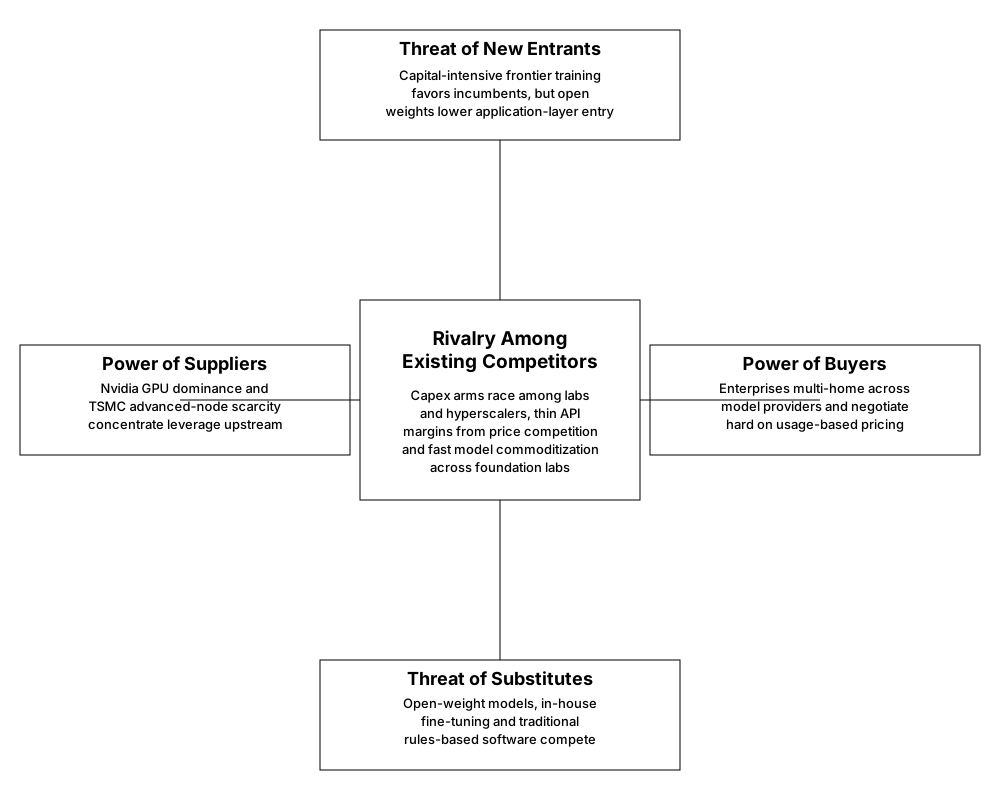
Porter's five forces framework, applied to this industry, reveals a market where supplier power and competitive rivalry dominate the strategic picture, while buyer power is rising quickly as enterprises grow more sophisticated about model selection and pricing negotiation. Entry barriers vary enormously by segment, from nearly insurmountable at the frontier training layer to genuinely low at the applied product layer and substitute threats come less from outside the industry than from within it, as open-weight models substitute for proprietary ones. The following sections examine each force in turn, grounded in the segmentation above rather than treating the industry as a single undifferentiated market.
Bargaining power of buyers
Enterprise buyers have gained substantial leverage over the past two years, a reversal from the earlier period when foundation model access felt scarce and sellers set terms unilaterally. The proliferation of capable models, both proprietary and open-weight, means most enterprise buyers can credibly threaten to switch providers and many now architect their systems specifically to avoid single-provider lock-in, routing requests across multiple models based on cost and task requirements. Large enterprise customers negotiating multi-year infrastructure commitments, such as major banks or telecommunications companies, can extract meaningful discounts given the scale of their spending and the intensity of competition among cloud providers courting them. Consumer buyers, by contrast, retain comparatively little power individually, though aggregate switching behavior, such as a wave of users abandoning a chatbot after a controversial update, can still discipline provider behavior at the margin. Government buyers occupy a distinct position, often able to demand custom terms, data residency guarantees and security certifications that smaller commercial buyers cannot, giving them outsized influence over how vendors design their compliance offerings. The overall trend favors buyers, driven by model commoditization at the mid-tier and the rise of procurement teams within enterprises who now treat Artificial Intelligence spending with the same rigor previously reserved for cloud infrastructure contracts.
| Buyer segment | Source of leverage | Constraint on leverage |
|---|---|---|
| Large enterprise accounts | Multi-model routing, volume discounts | Switching costs rise once workflows are deeply integrated |
| Mid-market and startups | Abundant open-weight and low-cost model options | Limited negotiating scale individually |
| Consumer subscribers | Low switching friction between apps | Limited technical sophistication to evaluate alternatives |
| Government and public sector | Scale of contracts, security requirements | Long procurement cycles reduce competitive pressure on incumbents |
Bargaining power of suppliers
Supplier power concentrates heavily in semiconductor design and manufacturing, where one company controls the overwhelming majority of the merchant Artificial Intelligence data center chip market, with independent estimates placing its share of data center graphics processing unit revenue at anywhere from roughly 70% to above 80%, depending on whether hyperscaler custom silicon is counted. That dominant position exists atop an even narrower chokepoint, since the advanced manufacturing needed to fabricate these chips is concentrated in a small number of foundries, giving fabrication providers enormous leverage over every chip designer that depends on them. Talent functions as a second critical supplier input and the market for researchers capable of training frontier models remains tight enough that compensation packages at leading labs now rival those in professional sports, reflecting genuine scarcity rather than mere signaling. Energy suppliers and grid operators have become an increasingly binding constraint as data center power demand accelerates, giving utilities and, in some regions, national governments unusual sway over where and how quickly new capacity can be built. Data suppliers, including licensing partners for proprietary content used in training, have gained leverage as labs seek to avoid the legal exposure associated with unlicensed web scraping, pushing up the cost of high-quality training data. Suppliers overall hold more structural power than buyers at the infrastructure layer, a dynamic unlikely to ease meaningfully before new chip fabrication capacity comes online later in the decade.
| Supplier category | Nature of leverage | Trend |
|---|---|---|
| Graphics processing unit and chip designers | Near-monopoly share of advanced training silicon | Slowly eroding as custom silicon scales |
| Advanced chip foundries | Sole source for cutting-edge manufacturing nodes | Structural, unlikely to shift near term |
| Research and engineering talent | Scarcity of frontier-capable specialists | Easing slightly as talent pool grows |
| Energy and grid capacity | Power availability constrains data center buildout | Tightening in several major markets |
Rivalry among existing competitors
Competitive intensity among foundation model labs has reached a pace few technology markets have sustained, with major releases arriving every few months and pricing on application programming interface access falling repeatedly as competitors match or undercut one another. Gartner forecasts worldwide Artificial Intelligence platform and model spending to grow 63% in 2026, a figure that reflects genuine demand growth but also masks how much of that spending goes toward an escalating capital arms race rather than toward proven, durable revenue.3 Labs compete simultaneously on multiple dimensions, including raw model capability, cost per query, latency, safety posture and ecosystem integration, which prevents any single competitor from winning outright even when it leads on one dimension. Cloud infrastructure providers compete just as fiercely for the same enterprise accounts, often subsidizing compute access to lock in customers who will later generate higher-margin services revenue, a strategy borrowed directly from the earlier cloud computing land grab. Venture funding intensifies this rivalry further, with recent rounds reaching extraordinary scale as leading labs and challengers alike raise tens of billions of dollars to fund continued price competition rather than near-term profitability. Rivalry at the applied product layer looks different, resembling conventional software competition where differentiation through data, workflow depth and customer relationships matters more than raw model access, since most applied vendors draw on similar underlying models.
| Competitive dimension | Where rivalry concentrates | Effect on margins |
|---|---|---|
| Frontier model capability | Foundation model labs | Compresses application programming interface pricing |
| Compute capacity and pricing | Cloud infrastructure providers | Pressures gross margin despite volume growth |
| Vertical workflow depth | Applied Artificial Intelligence vendors | Supports margin where switching costs are high |
| Developer ecosystem lock-in | Tooling and platform vendors | Builds durable revenue once adopted |
Threat of new entrants
Entry barriers diverge sharply by segment, making a single answer to this force misleading without qualification. Training a genuinely frontier-class foundation model now requires compute budgets running into the billions of dollars, effectively closing that specific competitive arena to all but a handful of organizations backed by either massive private capital or a hyperscaler balance sheet. Chip design and manufacturing carry even steeper barriers, given the decades of accumulated engineering knowledge, capital investment and intellectual property required to compete with incumbent foundries and designers. Applied Artificial Intelligence products sit at the opposite end of the spectrum, since a small team can build a viable product by licensing an existing model or fine-tuning an open-weight release, meaning thousands of new companies enter this layer every year with genuinely low capital requirements. Open-weight models have meaningfully lowered barriers across the middle of the value chain, letting new entrants skip the pretraining step entirely and compete instead on fine-tuning, product design and go-to-market execution. Regulatory requirements, particularly emerging high-risk system obligations under frameworks like the European Union's Artificial Intelligence Act, add a further barrier for entrants targeting regulated verticals such as healthcare, employment screening or credit decisioning, since compliance infrastructure requires upfront investment that favors better-capitalized entrants.
| Entry barrier type | Segment most affected | Height of barrier |
|---|---|---|
| Frontier training compute cost | Foundation model labs | Very high |
| Advanced manufacturing capacity | Chip design and fabrication | Very high |
| Model licensing and fine-tuning cost | Applied Artificial Intelligence products | Low |
| Regulatory compliance infrastructure | Regulated vertical applications | Moderate and rising |
Threat of substitutes
Substitution pressure in this industry comes overwhelmingly from within the industry itself rather than from unrelated technologies, which distinguishes it from most sectors analyzed under this framework. Open-weight models published by well-funded organizations act as a direct substitute for proprietary application programming interface access, since a company that can self-host a sufficiently capable open model avoids ongoing usage fees entirely, trading them for infrastructure costs it controls directly. Traditional rules-based software and simpler statistical models remain viable substitutes for many use cases where the accuracy gains from a large language model do not justify its higher cost and latency, particularly in narrow, well-defined tasks such as fraud flagging on structured transaction data. In-house model development, where a large enterprise builds and trains its own specialized model rather than licensing one, functions as a substitute for the largest buyers with sufficient data and engineering resources, though this remains rare outside the very largest technology and financial companies. Human labor remains an underappreciated substitute at the margin, since many buyers still default to manual processes when automated accuracy or reliability falls short of a threshold and this substitution threat cuts in the opposite direction from the other three, representing lost demand rather than demand shifted to a competitor. The net effect keeps pricing power in check across the middle of the value chain, even as demand for Artificial Intelligence overall continues to expand.
| Substitute type | Mechanism | Constraint it imposes |
|---|---|---|
| Open-weight self-hosted models | Removes recurring usage fees | Caps proprietary application programming interface pricing |
| Traditional rules-based software | Lower cost, adequate accuracy for narrow tasks | Limits displacement of legacy systems |
| In-house proprietary models | Avoids ongoing vendor dependency | Limited to largest, most resourced buyers |
| Manual human processes | Fallback when automation reliability is insufficient | Caps addressable automation demand |
Value chain and profit pools
The industry's value chain runs from raw material inputs through to the customer-facing applications that generate the revenue everyone else in the chain ultimately depends on. Understanding each stage clarifies where genuine defensibility exists versus where competitive pressure will keep compressing margin over time.
Upstream inputs begin with energy and raw materials, including the specialized minerals and manufacturing inputs needed for semiconductor fabrication, followed by the advanced chip manufacturing itself, concentrated in a small number of foundries capable of producing at the leading process nodes. Model training represents the next stage, where labs combine chips, energy, engineering talent and vast datasets to produce foundation models, an enormously expensive process that only a small number of organizations can afford to repeat at the frontier tier. Infrastructure and distribution follows, encompassing the cloud platforms and specialized compute providers who make trained models available for inference, along with the networking and data center capacity that inference depends on. The tooling and orchestration stage includes machine learning operations platforms, monitoring software and developer frameworks that help enterprises actually put models into production reliably rather than leaving them as impressive demonstrations. The application and customer interface stage is where applied Artificial Intelligence vendors and enterprise software companies package model capability into specific products, from coding assistants to marketing automation, that end customers actually purchase and use. Finally, the governance and enablement stage, encompassing compliance tooling, security auditing and data governance software, has grown from a peripheral concern into a distinct sub-industry as regulatory scrutiny intensifies.
Profit pool
Profit concentration in this industry has shifted upstream over the past two years, away from where most public attention still focuses. Chip designers and advanced foundries currently capture the highest and most durable margins in the entire value chain, a position reinforced by structural scarcity that shows no sign of easing before new fabrication capacity comes fully online later in the decade. Cloud infrastructure providers occupy the next tier of profitability, particularly those combining proprietary chip design with data center scale, since they capture margin both on the infrastructure layer and on higher-value managed services layered on top of raw compute. Foundation model labs generate enormous revenue, but their margins after compute costs remain thinner than their public valuations might suggest, squeezed between the chip and cloud providers above them in the chain and the competitive pricing pressure from rival labs below. Applied Artificial Intelligence vendors show the widest range of outcomes, since those with genuine data advantages or deep workflow integration sustain healthy software-like margins, while those merely wrapping a thin interface around someone else's model face the same commoditization pressure squeezing the labs themselves, only with less scale to absorb it. This pattern echoes the earlier cloud computing buildout, where infrastructure providers ultimately captured more durable value than many of the applications built atop them, though the applied layer in Artificial Intelligence retains more room for genuine differentiation than cloud applications typically did, given how much data and workflow specificity matters to model performance in narrow domains.
Industry economics and business models
Four business models dominate the industry's revenue generation, each with distinct economics and risk profiles that executives should evaluate independently rather than treating the industry as a single monolithic market. Usage-based application programming interface pricing, where customers pay per unit of computation consumed, dominates foundation model monetization and mirrors utility pricing more than traditional software licensing, since revenue scales directly with customer usage rather than seat count. This model rewards providers with the lowest marginal cost of serving each query, which explains why chip efficiency and infrastructure optimization have become central competitive battlegrounds rather than peripheral engineering concerns. Enterprise subscription licensing, more familiar from conventional software, characterizes much of the machine learning operations tooling and applied product segments, offering more predictable revenue but requiring genuine product differentiation to justify recurring fees once a customer could technically switch to a competitor. Consumption-based cloud infrastructure billing underpins the compute layer, where providers charge for graphics processing unit hours, storage and networking, a model that rewards scale since fixed data center costs spread across a larger customer base. A smaller but growing fourth pattern involves outcome-based or hybrid pricing, where vendors charge based on business results delivered, such as tickets resolved or code shipped, rather than raw computation consumed, a structure still uncommon but gaining traction as buyers push back against unpredictable usage-based bills.
Cost drivers and scalability
Cost structure varies enormously across the value chain and conflating the economics of a chip manufacturer with those of an applied software vendor leads to serious strategic misjudgment. At the infrastructure and frontier-training layer, fixed costs dominate overwhelmingly, since building a data center or fabricating advanced chips requires enormous upfront capital before a single unit of useful compute becomes available, creating powerful economies of scale that favor the largest, best-capitalized players. Marginal cost per inference query, by contrast, has fallen sharply as model efficiency techniques mature, meaning the cost of serving an additional customer query today is a fraction of what it was two years ago, a trend that benefits providers who can pass some of those savings through as competitive pricing while retaining margin. Applied Artificial Intelligence vendors face a cost structure closer to conventional software-as-a-service businesses, where customer acquisition cost and the ratio of that cost to customer lifetime value determine unit economics far more than raw compute expense, though compute still represents a meaningfully higher cost of goods sold than in pre-artificial-intelligence software. Economies of scope also matter considerably, since a foundation model trained once can serve thousands of distinct applications, spreading the enormous fixed training cost across a far larger revenue base than any single application could generate alone, which is precisely why general-purpose foundation models displaced the earlier era of bespoke, single-purpose machine learning systems. A genuine flywheel exists at the data layer, since usage generates feedback that improves models, which attracts more usage, though this loop has proven weaker in practice than early industry narratives suggested, given how much model improvement now comes from algorithmic and infrastructure gains rather than from incremental usage data alone.
Moats, advantages and strategic levers
Defensibility in this industry concentrates around four distinct sources and the strongest competitors typically combine more than one rather than relying on a single advantage. Cost advantage matters most at the infrastructure layer, where scale in chip procurement, data center construction and energy contracting compounds over time, letting the largest providers offer lower prices while sustaining higher margins than smaller rivals attempting to match them. Switching costs provide the most durable moat at the applied product layer, since once a company embeds an Artificial Intelligence tool into a core workflow, such as a coding environment or a customer service pipeline, the operational disruption and retraining cost of switching providers discourages migration even when a competitor offers marginally better performance. Data advantages remain real but narrower than commonly assumed, valuable primarily in domains with proprietary, hard-to-replicate datasets, such as a health system's clinical records or a financial institution's transaction history, rather than as a generic moat available to any company that has accumulated user interactions. Regulatory moats have begun to emerge as compliance requirements under frameworks such as the European Union's Artificial Intelligence Act raise the cost of operating in regulated verticals, an advantage that favors incumbents with existing compliance infrastructure over new entrants who must build it from scratch.
The scarcest resource in this industry is not talent or capital, it is proven, safe deployment at scale, which is exactly what fewer companies than expected have actually achieved
Network effects, often invoked loosely in discussions of this industry, apply more narrowly than in classic platform businesses, appearing mainly in developer ecosystems where third-party tools and integrations accumulate around a dominant platform, rather than in the underlying models themselves.
Strategic levers
Executives operating in or around this industry have five distinct levers available and the right combination depends heavily on which segment of the value chain a company occupies. Customer segment focus represents the most accessible lever for smaller players, since concentrating on a specific vertical, such as legal document review or industrial equipment maintenance, allows a company to build data and workflow advantages that a horizontal, general-purpose competitor cannot easily replicate. Product scope decisions, whether to build a narrow point solution or a broader platform spanning multiple use cases, carry real trade-offs, since narrow focus supports deeper differentiation while broader scope supports stronger account expansion economics once a customer relationship exists. Vertical integration versus partnering shapes long-term margin capture more than any other single decision and the evidence increasingly favors selective integration, where a company owns the layers closest to its core differentiation while partnering or licensing for commodity layers such as base model access. Geographic expansion carries unusual complexity in this industry given diverging regulatory regimes across the European Union, United States and China, making a genuinely global strategy considerably harder to execute than in most other technology sectors. Ecosystem orchestration, building a platform that other companies build on top of, offers the strongest long-term moat but requires scale and distribution that only a small number of companies currently possess, making it a realistic strategy for incumbents rather than most new entrants.
Structural risks, regulation and trends
The most immediate structural risk facing the industry is the widening gap between infrastructure capital expenditure and realized revenue, a dynamic drawing increasing scrutiny from public market analysts who worry that current spending commitments assume demand growth not yet fully proven at enterprise scale.4 Energy availability represents a second structural constraint, since data center power demand is growing faster than grid capacity can expand in several major markets, threatening to become the binding constraint on industry growth ahead of capital or even chip supply. Regulatory fragmentation across major jurisdictions adds compliance complexity and the European Union's Artificial Intelligence Act illustrates the pattern well, with core transparency obligations taking effect on schedule even as the Council of the European Union and Parliament agreed in mid-2026 to defer enforcement of certain high-risk system requirements to December 2027, creating a shifting compliance target that companies must track closely.5 Geopolitical risk concentrates heavily around semiconductor supply, given how much of advanced chip manufacturing capacity sits in a single geography facing ongoing political tension, a vulnerability no individual company's strategy can fully hedge against.
Enterprise adoption trends reveal a widening gap between broad usage and realized value, with roughly 88% of organizations now using Artificial Intelligence in at least one business function, yet only a small fraction, roughly 6% by some measures, qualify as high performers attributing more than 5% of earnings before interest and taxes to Artificial Intelligence.6 This gap creates a durable opportunity for vendors and consultants who can help enterprises convert broad pilot activity into measurable operational value, a capability gap likely to persist for several more years given how much organizational change, rather than pure technology adoption, that conversion requires. Agentic systems, capable of multi-step reasoning and autonomous tool use rather than single-response generation, represent the clearest near-term technology trend, shifting the unit of value from answer accuracy toward reliable task completion across a workflow, which in turn raises the bar for safety, monitoring and governance tooling.
For companies considering entry into this industry, the strategic playbook depends heavily on available capital and time horizon. Entrants with limited capital should avoid the frontier training race entirely and instead pursue a narrow vertical niche, building on licensed or open-weight models while investing differentiation dollars into proprietary data and workflow integration rather than model research. Entrants with substantial capital face a genuine build, partner or buy decision at the infrastructure layer, where partnering with an existing cloud provider typically offers faster time to market than building proprietary data centers, though it sacrifices some long-term margin capture. Regulatory strategy deserves explicit attention from any entrant targeting regulated verticals, since early investment in compliance infrastructure can become a genuine competitive advantage once regulatory enforcement intensifies, rather than merely a cost of doing business.
Incumbents face a different set of choices centered on defending existing position while expanding into adjacent opportunity. Defending market position requires continuous reinvestment in infrastructure and model capability even as returns on that reinvestment show early signs of diminishing, a tension that will likely force some rationalization of capital spending plans over the next two to three years. Expanding into adjacent segments, such as a foundation model lab moving into applied vertical products, offers a path to capture more of the value chain, though it risks channel conflict with the very applied vendors who currently serve as the lab's customers. Deepening moats through data advantages and workflow integration, rather than through model capability alone, represents the most durable defensive strategy available to incumbents, precisely because model capability itself commoditizes faster than almost any other input in the value chain.
Caselet: Nvidia's shift from graphics chips to AI infrastructure backbone
Nvidia Corporation's trajectory from a graphics chip designer serving video game enthusiasts to the dominant supplier of Artificial Intelligence training infrastructure illustrates how supplier power concentrates in this industry more clearly than any other single company's history. Founded in 1993 to build graphics processing chips for personal computers, the company spent its first two decades competing in the cyclical, margin-thin market for gaming graphics cards, a business that taught it to design highly parallel processors capable of performing many calculations simultaneously. That parallel architecture, originally built to render video game graphics quickly, turned out to be almost perfectly suited to the matrix mathematics underlying neural network training, a connection researchers began exploiting around 2012 as deep learning techniques started outperforming older machine learning approaches on image recognition tasks.
Market position and financial scale
Nvidia's data center segment, which barely existed as a meaningful revenue line a decade ago, generated tens of billions of dollars in quarterly revenue through 2026, growing at double-digit rates year over year and pushing full fiscal year data center revenue well past $190 billion.7 That scale reflects a market position independent analysts estimate at somewhere between 70% and 87% of merchant Artificial Intelligence data center chip revenue, depending on whether hyperscaler-designed custom silicon is counted in the total addressable market. The company sustained this position not merely through chip performance but through a software layer called CUDA, a programming platform introduced in 2007 that let researchers write code for Nvidia's parallel processors long before Artificial Intelligence workloads became commercially significant, creating a developer ecosystem that competitors have struggled to replicate even when offering comparable or superior raw hardware performance.
Strategic response to customer concentration
Nvidia's most significant strategic challenge now comes from its own largest customers, the hyperscale cloud providers who collectively represent an enormous share of its revenue while simultaneously funding internal chip design programs, including Google's tensor processing units, Amazon's Trainium chips and Microsoft's Maia silicon, explicitly intended to reduce their dependence on Nvidia over time. The company has responded by pushing further into systems-level offerings, selling entire server racks and networking infrastructure rather than individual chips, a move that raises the switching cost for any customer considering a shift to in-house silicon and defends against commoditization at the component level. It has also expanded into software and services more aggressively, recognizing that the CUDA ecosystem's defensibility depends on continuously extending its lead in tooling and libraries rather than resting on hardware performance alone.
Lessons for the broader industry
Nvidia's position demonstrates two dynamics visible across the wider value chain examined in this analysis. First, the company that owns the scarcest input, in this case advanced parallel computing chips, has captured more durable margin than the foundation model labs that consume its chips, even though those labs generate more public attention and, in several cases, higher revenue growth rates. Second, Nvidia's own vulnerability, facing customer-funded substitution from the very hyperscalers buying its chips at scale, illustrates that no position in this industry remains permanently secure and that even dominant suppliers must continuously invest in defensibility beyond raw product performance, whether through software ecosystems, systems integration or deepening switching costs, to sustain the margin their current market position implies.
The company's history also points to a broader lesson about timing and optionality in this industry. Nvidia did not set out to build Artificial Intelligence infrastructure, it built general-purpose parallel computing capability that happened to align with a technology shift its own leadership only partially anticipated in advance, a reminder that durable positioning in fast-moving technology markets often comes from building flexible, general-purpose capability rather than betting narrowly on a specific application from the outset.
Artificial Intelligence has become the organizing infrastructure layer of the technology economy, converting compute and data into decision-making at scale for buyers across every sector and geography. Its economics reward owners of scarce inputs, chips, power and proprietary data, over owners of models, which commoditize faster than most executives expect. The durable strategic levers are vertical specialization, workflow embedding and disciplined capital allocation toward infrastructure that outlives any single model generation. Incumbents that defend through distribution and applied depth, rather than model scale alone, will capture more of the value being created. Entrants succeed by avoiding the frontier training race entirely and building where switching costs and data advantages compound.
Citation
Cite this article
Sridharan, M. A. (2023, February 14). Industry Analysis: Artificial Intelligence. Think Insights. https://thinkinsights.net/data-ai/industry-analysis-artificial-intelligence (Accessed [[ACCESS_DATE]])
Sridharan, Mithun A. "Industry Analysis: Artificial Intelligence." Think Insights, 14 Feb. 2023, https://thinkinsights.net/data-ai/industry-analysis-artificial-intelligence. Accessed [[ACCESS_DATE]].
Mithun A. Sridharan, "Industry Analysis: Artificial Intelligence," Think Insights, February 14, 2023, https://thinkinsights.net/data-ai/industry-analysis-artificial-intelligence. Accessed [[ACCESS_DATE]].
Sridharan, M.A. (2023) 'Industry Analysis: Artificial Intelligence', Think Insights. Available at: https://thinkinsights.net/data-ai/industry-analysis-artificial-intelligence (Accessed: [[ACCESS_DATE]]).
M. A. Sridharan, "Industry Analysis: Artificial Intelligence," Think Insights, 2023. [Online]. Available: https://thinkinsights.net/data-ai/industry-analysis-artificial-intelligence. [Accessed: [[ACCESS_DATE]]].
Sridharan MA. Industry Analysis: Artificial Intelligence. Think Insights. Published February 14, 2023. Accessed [[ACCESS_DATE]]. https://thinkinsights.net/data-ai/industry-analysis-artificial-intelligence
Test Your Knowledge
Industry Analysis: Artificial Intelligence
Challenge yourself on the concepts from this article and see how well you understood them.
Subscribers get weekly quizzes and insights — subscribe free
Sponsor this article
Partner with Think Insights
Reach 50,000+ business leaders, consultants, and strategists. Feature your brand alongside expert articles on strategy, leadership, and digital transformation.
Become a Sponsor