CoinGecko Business Model


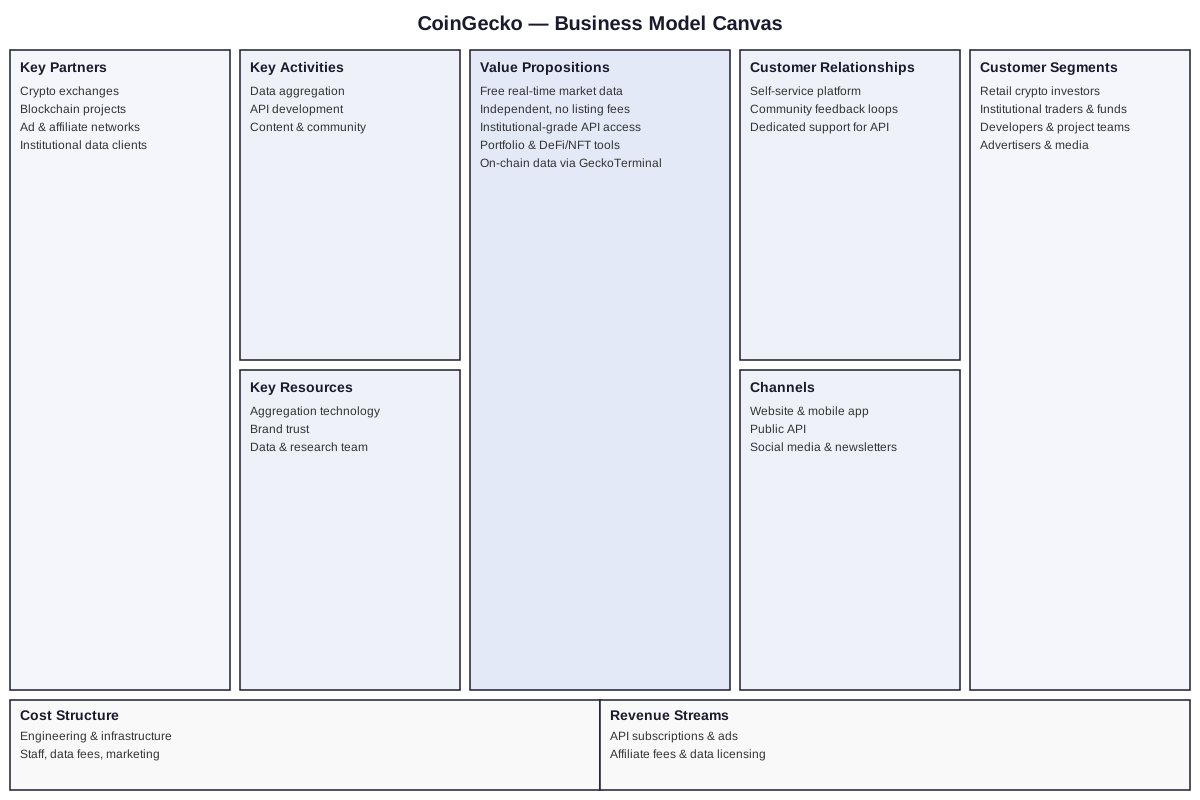
CoinGecko started in 2014 as a side project by two Singapore-based founders, TM Lee and Bobby Ong, who wanted reliable price data for a market flooded with hype and self-reported numbers. Eleven years later, the company lists roughly 15,000 curated tokens, feeds data to thousands of applications through its application programming interface [API] and never charges projects a listing fee. Its business model rests on a simple trade: give away market data for free, then convert the resulting traffic and trust into paid API access, advertising placements, affiliate commissions and analytics for institutions. The approach keeps CoinGecko accessible to retail investors while building a revenue base that does not depend on any single exchange or token's success. This analysis examines how that structure works, what changed with its 2025 leadership transition and what risks still sit ahead of it.
How does CoinGecko make money without charging users?
CoinGecko keeps its core price and market data free, then earns revenue from premium API subscriptions, advertising and sponsored placements, affiliate commissions and analytics covering DeFi and NFT markets. Keeping the free layer intact protects the traffic that makes the paid products valuable.
Why doesn't CoinGecko charge crypto projects to get listed?
Charging for listings would let better-funded projects buy visibility regardless of legitimacy. CoinGecko instead runs projects through an internal evaluation process before adding them, then earns money separately through advertising and API access.
What makes CoinGecko different from CoinMarketCap?
Both platforms track similar market data, but CoinGecko built its identity around community input, transparent methodology and a broader toolset spanning portfolio tracking, DeFi analytics and an on-chain product called GeckoTerminal. CoinMarketCap's ownership by the exchange Binance also raises neutrality questions that CoinGecko, as an independent company, does not face the same way.
Origins in Singapore's crypto scene
CoinGecko began in April 2014 as a side project between two friends in Singapore, TM Lee and Bobby Ong. The cryptocurrency market at the time ran on unreliable numbers:
exchanges self-reported trading volume with little independent verification, and no single source pulled that data into one consistent view
Lee and Ong built a simple aggregator that pulled prices and volumes across multiple exchanges and displayed them on one page, betting that reliable information would matter more than flashy design.
The bet paid off during the 2017 bull run, when trading interest surged and CoinGecko added on-chain metrics, developer activity tracking and decentralized finance [DeFi] statistics to keep pace with a market that had grown far more complex than simple price charts. The company had struck partnerships across the blockchain industry by 2018 and built a reputation for listing altcoins that larger, more selective exchanges ignored. That willingness to track the long tail of the market, rather than only the largest tokens, became one of the traits that separated CoinGecko from competitors chasing the same audience.
What began as a two-person side project now runs as a distributed team serving users in more than 170 countries, pulling data from several hundred exchanges into a single reference point for the market. The company never took a large venture round to get there, which meant growth had to be funded largely by the business itself rather than by outside capital chasing a fast exit. That constraint shaped the culture of the place:
features shipped when the data behind them was solid, not on a schedule set by investors wanting a quick story to tell
Turning free data into a trust asset
CoinGecko's foundational decision is also its simplest:
the platform does not charge cryptocurrency projects for a listing, and it says so explicitly to discourage scammers from claiming otherwise1
coingecko.com/en/methodology). Instead, new tokens go through an internal review that checks for a working product, an active team and verifiable trading activity before they appear in search results. That review process costs staff time and slows how quickly new tokens reach the site, a trade-off the company accepts because listing fees would let poorly vetted projects buy visibility.
The payoff shows up in how much traffic the free tier generates. Millions of monthly visitors come to CoinGecko for price and volume data, and every visit is an opportunity to display an ad, promote a premium API tier or route a user toward an exchange referral link. Free access is not charity; it is the acquisition channel that funds everything else the company sells.
The same logic extends to how CoinGecko documents its own process. The company publishes the criteria it uses to rank exchanges and calculate trading volume, including how it adjusts for wash trading and other reported figures that inflate a venue's apparent liquidity. Publishing that methodology invites outside scrutiny, but it also gives institutional clients a documented basis for using CoinGecko data in their own compliance and reporting work, which is precisely the audience willing to pay for premium access.
Four ways CoinGecko turns traffic into revenue
CoinGecko converts that traffic into revenue through several channels rather than a single product line. The largest is data as a service:
a paid application programming interface [API] that gives developers, hedge funds and other financial institutions higher rate limits, historical data and analytics that the free public API does not offer
Independent review platforms list multiple paid tiers for that API, priced by call volume and data depth, letting CoinGecko serve everyone from a solo developer building a portfolio tracker to a bank running compliance checks2.
Beyond the API, CoinGecko sells access to specialized data on non-fungible tokens [NFTs] and DeFi protocols, two segments that did not exist when the company launched but now generate their own subscriber base among funds and researchers tracking those markets. Each new data category follows the same logic as the original price aggregator:
build the free layer first to attract users, then charge the subset of users who need more depth or reliability than the free tier provides
Institutional demand for that depth has grown alongside the number of exchanges and trading pairs CoinGecko covers. A hedge fund pricing a basket of tokens across dozens of venues, or a bank building a crypto custody product, needs a data feed that updates continuously and reconciles differences between exchanges automatically, not a dashboard designed for a retail investor checking a price once a day. Selling that reliability at a price point institutions can justify internally is a different business from selling banner ads, and running both under one roof is what lets CoinGecko fund product development without leaning on a single customer type.
Advertising, affiliates and the attention economy
Advertising is the second major pillar, and it works because CoinGecko controls placement on pages that crypto projects want their audience to see. Display ads and sponsored listings appear on market pages during moments that matter most to a project, such as a token launch or a major protocol upgrade, when demand for visibility peaks. Aimann Faiz, CoinGecko's head of business development, described the logic behind the model directly:
Our business model is to capture the value from all visitors, we monetize this through banner ads, buttons and content3
Affiliate marketing runs alongside advertising. When a visitor clicks through to an exchange from a CoinGecko referral link and completes a trade, the exchange pays CoinGecko a share of the fee generated. The arrangement works because CoinGecko's audience already trusts its data, so a referral carries more weight than a generic ad. None of these channels depends on the others succeeding, which is the point:
a slow month for advertising does not have to mean a slow month for API subscriptions or affiliate commissions
Both revenue lines also move in step with the broader market's attention cycle, which is a double-edged feature of the model. When trading volume rises, more projects launch, more tokens change hands through referral links and more advertisers compete for the same banner slots, so CoinGecko's advertising and affiliate income tend to climb together during active markets. The company's task is converting that cyclical upside into steadier commitments, such as annual advertising contracts or long-term API deals, rather than depending entirely on whatever mood the market happens to be in during a given quarter.
GeckoTerminal and the on-chain frontier
CoinGecko's most significant recent expansion is GeckoTerminal, a sister product that tracks trading activity directly on the blockchain rather than through centralized exchange listings. Where CoinGecko lists a curated set of roughly 15,000 tokens that have passed an internal vetting process, GeckoTerminal tracks millions of tokens as they trade on decentralized exchanges, with no equivalent screening step. The two products serve different audiences by design:
CoinGecko for users who want a filtered, reliable view of the market, and GeckoTerminal for traders willing to accept more noise in exchange for faster access to newly launched tokens
Running both products lets CoinGecko capture revenue from two different risk appetites without diluting either brand. A curated, cautious audience keeps trusting the main platform's data, while a faster-moving audience trades on GeckoTerminal, and the company sells advertising and data access to both groups separately.
The gap in scale between the two products illustrates how much the on-chain token market has expanded beyond what any curated list can cover. GeckoTerminal tracks activity across millions of token pairs on decentralized exchanges, the overwhelming majority of which will never pass CoinGecko's own listing review because they lack a working product, an identifiable team or sustained trading activity. Rather than treat that gap as a threat to the core business, CoinGecko built a second product around it, which keeps the company relevant to a segment of the market that would otherwise look to a dedicated on-chain analytics competitor instead.
Ownership and the 2025 leadership transition
CoinGecko has remained privately held throughout its history, with Lee and Ong retaining significant ownership stakes as founders. Company profile records list a small number of institutional backers rather than the large venture rounds common among crypto exchanges, with MEXC Pioneer holding a minority position4, 5. That ownership structure matters commercially: a company answerable to a small group of long-term stakeholders, rather than public markets or a large venture syndicate demanding rapid growth, can afford to keep its core data free even when that choice slows revenue growth.
The clearest sign of that long-term orientation came in August 2025, when Ong moved from chief operating officer to chief executive and Lee shifted to the newly created role of president, focused on long-term product and research work. TM Lee explained the rationale behind the change:
Bobby's strategic foresight, operational excellence and deep understanding of the crypto ecosystem make him the ideal leader to steer CoinGecko into its next phase of growth
The transition kept both founders inside the company rather than exiting, which matters for a business whose main asset is the credibility investors and users place in its data. Alongside the CEO change, CoinGecko also named a chief technology officer and a head of product, a restructuring aimed at scaling the underlying data infrastructure and integrating Artificial Intelligence into how the platform processes and summarizes market information. Promoting from within, rather than hiring an outside executive to run the company, sent a signal to staff and partners that continuity mattered more than a fresh public narrative.
Competing in a crowded market
CoinGecko operates in a market with several credible competitors, including CoinMarketCap, Messari, CryptoCompare, Kaiko, CoinStats and LiveCoinWatch, each with a different specialty. CoinMarketCap remains the most recognized name and benefits from ownership by Binance, one of the largest exchanges in the world, while Messari and Kaiko lean toward institutional research and enterprise-grade data feeds rather than retail traffic. CoinStats focuses on portfolio management across hundreds of wallets and exchanges, competing with CoinGecko's own tracking tools rather than its market data.
CoinGecko's response to that competition has been breadth rather than specialization:
covering more tokens, publishing free market reports and maintaining a public profile that has drawn recognition beyond the crypto press, including coverage from mainstream business outlets tracking the company's growth and reach6
forbes.com/profile/coingecko/). That visibility functions as marketing, reinforcing the brand recognition that keeps users choosing CoinGecko over a rival with similar data.
Independence from any exchange also protects CoinGecko from a conflict that has followed several of its rivals since exchanges began buying up data providers to control how their own listings and trading volume get reported. A trader comparing prices across venues has less reason to trust a data source owned by one of the venues being compared, and CoinGecko has built its commercial identity around not carrying that particular liability, even though staying independent means funding growth from its own revenue rather than from an exchange's balance sheet.
Risks tied to crypto cycles
CoinGecko's revenue model carries the same cyclicality as the market it covers. Advertising budgets from crypto projects contract sharply during downturns, when marketing is often the first cost projects cut, and affiliate commissions fall alongside trading volume on partner exchanges. A prolonged bear market would pressure two of the company's revenue streams at once, even if API subscriptions from institutional clients hold up better because those buyers need continuous data regardless of price direction.
Regulatory pressure adds a second layer of uncertainty. Governments in major markets have tightened rules around crypto marketing and exchange referrals, and any restriction on affiliate arrangements or sponsored listings would remove a meaningful piece of CoinGecko's revenue mix without a guaranteed replacement. The company's response so far, spreading revenue across data services, advertising, affiliate deals and niche analytics rather than relying on any single stream, gives it more room to absorb a shock in one channel than a competitor built around a single revenue source would have.
- 1[CoinGecko's Data Methodology And Listing Policy](https://www
- 2CoinGecko API Pricing Tiers On G2
- 3Aimann Faiz On CoinGecko's Business Model
- 4CoinGecko Company Profile On Crunchbase
- 5CoinGecko Ownership Profile On PitchBook
- 6[CoinGecko Company Profile On Forbes](https://www
CoinGecko's growth path shows that data neutrality can be a durable commercial asset in a market prone to conflicts of interest. Refusing listing fees and keeping core data free built the kind of trust that advertisers, exchanges and institutional clients now pay to access. Its 2025 leadership transition, handing the chief executive role to Bobby Ong while TM Lee shifts to long-term product work, signals a company preparing for a longer horizon rather than a short-term exit. The bigger test ahead is whether CoinGecko can keep diversifying revenue fast enough to offset the swings in advertiser demand and trading volume that come with every crypto cycle. Its answer so far, spreading activity across API subscriptions, sponsored placements, affiliate deals and on-chain data through GeckoTerminal, treats volatility as a planning input rather than an obstacle.
Citation
Cite this article
Sridharan, M. A. (2025, June 15). CoinGecko Business Model. Think Insights. https://thinkinsights.net/data-ai/coingecko-business-model (Accessed [[ACCESS_DATE]])
Sridharan, Mithun A. "CoinGecko Business Model." Think Insights, 15 June 2025, https://thinkinsights.net/data-ai/coingecko-business-model. Accessed [[ACCESS_DATE]].
Mithun A. Sridharan, "CoinGecko Business Model," Think Insights, June 15, 2025, https://thinkinsights.net/data-ai/coingecko-business-model. Accessed [[ACCESS_DATE]].
Sridharan, M.A. (2025) 'CoinGecko Business Model', Think Insights. Available at: https://thinkinsights.net/data-ai/coingecko-business-model (Accessed: [[ACCESS_DATE]]).
M. A. Sridharan, "CoinGecko Business Model," Think Insights, 2025. [Online]. Available: https://thinkinsights.net/data-ai/coingecko-business-model. [Accessed: [[ACCESS_DATE]]].
Sridharan MA. CoinGecko Business Model. Think Insights. Published June 15, 2025. Accessed [[ACCESS_DATE]]. https://thinkinsights.net/data-ai/coingecko-business-model
Test Your Knowledge
CoinGecko Business Model
Challenge yourself on the concepts from this article and see how well you understood them.
Subscribers get weekly quizzes and insights — subscribe free
Sponsor this article
Partner with Think Insights
Reach 50,000+ business leaders, consultants, and strategists. Feature your brand alongside expert articles on strategy, leadership, and digital transformation.
Become a Sponsor