SQVID


Sometimes, the best solutions are the simplest and the most obvious ones. In consulting, visualizing key insights help clients better assimilate and implement your recommendations. The best way to communicate with your clients and sell your ideas is through visualizations. The SQVID technique is an extremely easy and brilliant technique that will allow you to win your clients' admiration by showing them your idea. It is a practical tool of applied imagination. The keyword, in this case, is showing – you transfer your idea into your clients' imagination and allow them to see it the way you do.
What does SQVID stand for?
SQVID stands for Simple, Quality, Vision, Individual, and Change. Each letter represents a dimension for evaluating and improving how ideas are visually communicated.
Who created the SQVID technique?
Dan Roam introduced SQVID in his book The Back of the Napkin as a visual thinking tool to help people examine subjects from multiple perspectives.
How does SQVID help consultants?
It encourages consultants to brainstorm visually, simplify complex ideas, focus on quality over quantity of analysis, and present findings in ways clients can easily understand and act on.
What does the 'Vision' component emphasize?
Vision focuses on visualizing key assumptions and scenarios rather than showing raw analytical models. Comparing scenarios visually helps clients grasp the practical impact of recommendations.
What does the 'Change' component mean in a consulting context?
When clients request additional analysis or revisions, consultants should seek context before acting, push back if needed, and avoid implementing changes carelessly just to satisfy immediate requests.
Dan Roam first described this technique in his book, "The Back of the Napkin". In the Napkin Academy, he describes the SQVID as a visual thinking tool. He also encourages people to do is take a subject and apply the SQVID to it. For consultants, the SQVID technique is a great way to visually brainstorm ideas, look at the client challenge from multiple perspectives and stretch your imagination to arrive at creative solutions. Often, clients complain that consultants only create visually compelling slideware. However, the SQVID technique is a great Segway to get from Point A - death by PowerPoint to Point B - truly engaging presentation. For those of you who know and practice the philosophies of Edward Tufte, Gary Reynolds and Nancy Duarte, this text is a must-read.
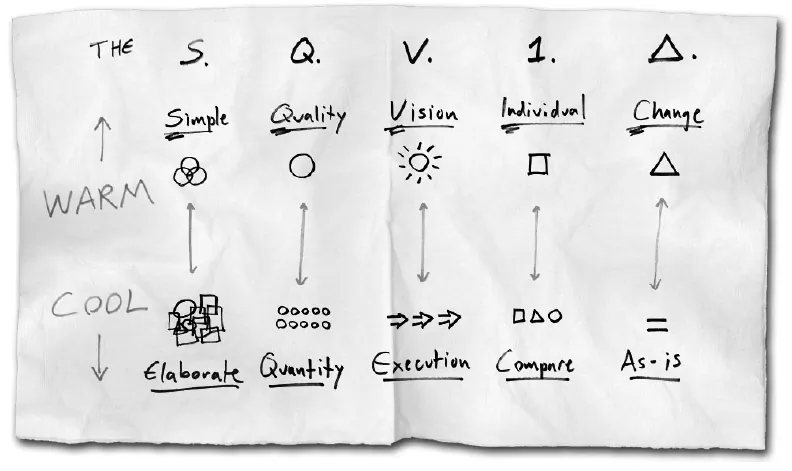
S is for Simple
Imagine your client as a 5-year-old kid. He might not an expert in business analysis and strategy as you are. Using long intimidating words and concepts that you picked up in your business school to explain your opinions will not only confuse him, but might also put him off.
Try telling a 5-year-old kid that eating lots of sweets is really bad because sweets contain too much glucose that erases the level of sugar in his blood. I doubt that he will stop eating sweets!
Remember that simple concepts and communication are the winning ones. The simpler and clearer your message is, higher the odds that it will stick and that your clients will follow through on your recommendations.
Q is for Quality
The most crucial thing is the quality of your communication and the work you did for your client. As consultants, we want to conduct several analyses to showcase our analytical prowess. The fact is, clients don't care much for the number of analyses you performed or the methodologies you used / know. However, if you focus on a few key objectives and conduct extensive analyses around those objectives, your chances to bring your recommendations to the highest levels of quality and perfection are much higher than when you create lots of shallow analyses of poor quality. Your clients will notice your efforts and really appreciate your opinions and recommendations.
V is for Vision
The most important part of making your client understand the future of their business are the design and conceptual choices you have in mind. These are concealed in the assumptions you used in your analytical models. The next, if not the most important, step is actually visualizing or articulating these assumptions. Your client isn't interested in the way you did your analyses, so don't show him your analytical models. An example will demonstrate this concept:
You see, if you increase your price by 2%, you will have 200 fewer customers. That's wrong! Because, your senior stakeholder would have no idea what it means to her gross earnings and profits, in turn, her bonus. Instead, show her an overlaid visualization with revenues and margins with 3 scenarios:
- At 2% discount
- Current price, and
- At 2% mark up
She'll quickly and easily understand that offering a 2% discount will win her, perhaps, 400 more customers, 5% more revenue and that she'll meet her goals for that year, which would earn her bonus. She'll also be probably thinking of engaging you for the next challenge she's currently tackling! Nice!
Show, don't tell! Compare and contrast! Use colors to your advantage, especially if a particular strategy will lead to losses. Your clients will love you! Don't make your clients guess – better show them your analyses in practice. This is what visualization is all about!
I is for Individual
Your visualization should be better than anything else. Don't make the client compare it with other presentations she has. Provide her with an understanding that your recommendations are really worth her attention. Emphasize its individuality and uniqueness. The phrases, such as:
You see, the confidence interval is 99%. The recommendation to pursue strategy X is better because of this metric and the rigor of our analysis. Other approaches won't do because they don't perform well on the confidence interval metric. Your client has to notice this difference herself. All you need to do is to point it out in terms of an actual visualization.
D is for Change
Usually, changes don't start with D. However, they are still significant for the SQVID tool. The SQVID technique has its origins in design and D is the final stage of the applied imagination process. In consulting, if your client provides you additional inputs, asks you for additional analysis, or proposes changes based on new developments, then you have include them in your work. But, before you jump headlong into these activities, probe your client for additional background information and ask questions that will help you understand the context. Don't implement those changes in your analyses in a careless way, just for the sake of doing them. If required, push back or challenge your clients. You cannot fool your clients and mess with them by doing the changes in an sloppy way or agreeing to all their proposals just to assuage them for that moment.
SQVID tool stands for a visual thinking and helps you to take your vague idea to your client's specific understanding and implement it further in life. Though compelling visualizations, you make sure that your clients grasp the concepts you're talking about and can see it with their own eyes.
Citation
Cite this article
Sridharan, M. A. (2019, May 30). SQVID. Think Insights. https://thinkinsights.net/consulting/sqvid (Accessed [[ACCESS_DATE]])
Sridharan, Mithun A. "SQVID." Think Insights, 30 May 2019, https://thinkinsights.net/consulting/sqvid. Accessed [[ACCESS_DATE]].
Mithun A. Sridharan, "SQVID," Think Insights, May 30, 2019, https://thinkinsights.net/consulting/sqvid. Accessed [[ACCESS_DATE]].
Sridharan, M.A. (2019) 'SQVID', Think Insights. Available at: https://thinkinsights.net/consulting/sqvid (Accessed: [[ACCESS_DATE]]).
M. A. Sridharan, "SQVID," Think Insights, 2019. [Online]. Available: https://thinkinsights.net/consulting/sqvid. [Accessed: [[ACCESS_DATE]]].
Sridharan MA. SQVID. Think Insights. Published May 30, 2019. Accessed [[ACCESS_DATE]]. https://thinkinsights.net/consulting/sqvid
Test Your Knowledge
SQVID
Challenge yourself on the concepts from this article and see how well you understood them.
Subscribers get weekly quizzes and insights — subscribe free
Sponsor this article
Partner with Think Insights
Reach 50,000+ business leaders, consultants, and strategists. Feature your brand alongside expert articles on strategy, leadership, and digital transformation.
Become a Sponsor