ShuHaRi


When you decide to learn a new skill, mastering it doesn't happen overnight. A learning process occurs as you immerse yourself in the practice of the skill. ShuHaRi is a Japanese martial art concept that describes the stages of learning to mastery. You can easily adapt this concept to consulting & other disciplines that rely on apprenticeship model.
What does ShuHaRi mean?
ShuHaRi is a Japanese concept with three stages: Shu (follow the rule), Ha (break the rule), and Ri (be the rule). It describes progressive mastery of a discipline.
Where did ShuHaRi originate?
The concept was first presented by Fuhaku Kawakami as Jo ha kyū in the Tao of Tea, later extended by Noh master Zeami Motokiyo, and subsequently adopted in Aikido philosophy.
How does ShuHaRi apply to management consulting?
Consulting relies on cognitive skills learned through real-world practice. ShuHaRi maps well to consulting apprenticeship because it emphasizes progressive skill development in authentic, context-dependent situations.
What is the main risk when applying ShuHaRi?
A learner in the Shu stage may incorrectly believe they have reached the Ri stage and break rules prematurely. This is linked to the Dunning-Kruger effect, where skill level is overestimated.
How does McKinsey reflect an apprenticeship model similar to ShuHaRi?
McKinsey assigns new consultants a non-evaluative buddy and encourages informal mentoring. Partners review mentor lists twice yearly, reinforcing structured, relationship-based learning consistent with apprenticeship principles.
In Western societies, very few communities have a structured approach as ShuHaRi to lead a pupil from Novice to Master. For example, in Germany, such a learning system still exists. This system originated among the artisan community during the medieval times. According to this system, one starts as an Apprentice, becomes Journeyman and finally a Master. A pupil should demonstrate the level of knowledge and craftsmanship governed by strict criteria to progress to the next stage.
Medieval origins
The apprenticeship is a well proven system, dating form back in the medieval ages, to preserve the knowledge of the artisans, such as blacksmiths, carpenters, watchmakers, etc. To learn the necessary skills, apprentices would work alongside the Master for 8-15 years. When an apprentice learned and demonstrated all the skills necessary, the Master would pronounce the apprentice to be a Master. Then, both masters got new apprentices.
Management Consulting & Apprenticeship
The consulting profession is based on an apprenticeship model. This is also true for other professional services, such as legal, accounting, etc. In the apprenticeship model, a master coaches the apprentice on the skills and methods of the craft. Though many consulting skills can be learned from books, online courses, etc., real learning happens in-person, on the job during interactions with your team and the client. A traditional apprenticeship experience, based on skill development involves learning a procedure and gradually developing mastery, during which the master and learner go through several stages. According to Pratt and Johnson1:
It is useful to remember that apprenticeship is not an invisible phenomenon. It has key elements: a particular way of viewing learning, specific roles and strategies for teachers and learners, and clear stages of development, whether for traditional or cognitive apprenticeship. But mostly it's important to remember that in this perspective, one cannot learn from afar. Instead, one learns amid the engagement of participating in the authentic, dynamic and unique swirl of genuine practice.
Apprenticeship in consulting
In The Reflective Practitioner: How Professionals Think in Action2, Schön opines that apprenticeship operates in:
situations of practice that…are frequently ill-defined and problematic, and characterized by vagueness, uncertainty and disorder. Learning in apprenticeship is not just about learning to do (active learning), but also requires an understanding of the contexts in which the learning will be applied. In addition there is a social and cultural element to the learning, understanding and embedding the accepted practices, customs and values of experts in the field.
Vagueness, uncertainty, disorder. Sounds familiar to the challenges consultants tackle, right? Hence, the apprenticeship method is well suited to learning in the consulting context.
Why this works in consulting?
Increasingly, consulting firms are gravitating towards apprenticeship models because the cognitive elements in engagements have significantly increased. In consulting, the emphasis is on cognitive rather than physical skills. Situated learning theory identifies the importance of presenting knowledge in an authentic context that involves its application. Learning should not be viewed as transmission of abstract and contextualized knowledge between individuals. Instead, it is a social process within certain conditions which include activity, context and culture. As the apprenticeship method focuses on the progressive development of skills in a real-world situation, this model is ideally suited for the consulting profession.
Case – McKinsey
McKinsey employs an informal apprentice model. It places strong emphasis on training. Once a consultant enters McKinsey, he or she gets a buddy. A buddy is someone in the firms who is a couple of years ahead and whose role is completely non-evaluative. McKinsey also encourages its consultants to find informal mentors. The company conducts a survey every 6 months and asks Analysts and Associates to list their mentors. It then circulates list among partners. McKinsey consistently marvels the intellectual power of their colleagues. In addition, the best and brightest learn from each other in addition to their superiors.
ShuHaRi
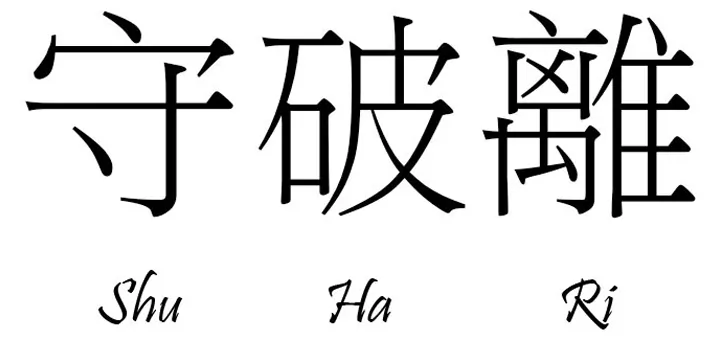
ShuHari is a proven Japanese apprenticeship framework that leads to mastery. The Shuhari concept was first presented by Fuhaku Kawakami as Jo-ha-kyū in Tao of Tea. Then, Zeami Motokiyo, the master of Noh, extended this concept to his dance as Shuhari, which then became a part of the philosophy of Aikido. According to this framework, the three phases of mastery are:
- Shu
- Ha, and
- Ri
In the Shu stage, the student does exactly as the Sensei (the teacher) says. The pupil endlessly practices copying the Sensei's examples without questioning why & without doubt. When the teacher decides the pupil is ready, he can move to the Ha stage. In the Ha stage, the student can question the skills he has learned. Finally, when a good pupil understands all the reasons for why we do as we do, he can follow his own path. Now, he can try to improve what was the best practice so far. This then becomes the Ri stage.
Shu
"protect", "follow the rule": in this phase the practitioner applies every method, approach or rule that the teacher provides. The pupil follows the rules to the letter. This is where it's important to follow every detail, even if it seems unimportant, and not deviate from the teachings. This is the phase when the pupil learns a new discipline, approach or technique in its intimacy, step by step. The pupil repeats the rules over and over in order to assimilate them. This is important because following a single path till the end is the most efficient way to learn. Thus, the pupil internalizes the knowledge and skills , which then become muscle memory.
Ha
"cut", "break the rule": the pupil has now reached a level where all he / she knows all rules. At this stage, the pupil might break the rules when necessary. Now, the pupil can also teach other learners, discuss the topic and improve the discipline itself. This is when the pupil can question the rules to understand the reason of their existence. Subsequently, the foundation becomes visible from the high point of the Shu studies.
Ri
"depart", "be the rule": the pupil now doesn't just follow the rule, methods and approaches. Instead, the pupil is the rule & transcends it. The pupil has, by now, so well assimilated the concepts that are the rules are second nature. Now, the pupil can even completely abandon the rules, if the goal requires it. In short, the pupil now extends the discipline. Overall, ShuHaRi is a brilliant concept in its simplicity. However, you should exercise caution. A Shu learner could think of being at the Ri stage and try to break the rule too soon. In other words, the pupil may fail to recognize his / her skill level & fall victim to the Dunning-Kruger effect. Aikido master Endō Seishirō shihan stated:
It is known that, when we learn or train in something, we pass through the stages of shu, ha, and ri. These stages are explained as follows. In shu, we repeat the forms and discipline ourselves so that our bodies absorb the forms that our forebears created. We remain faithful to these forms with no deviation. Next, in the stage of ha, once we have disciplined ourselves to acquire the forms and movements, we make innovations. In this process the forms may be broken and discarded. Finally, in ri, we completely depart from the forms, open the door to creative technique, and arrive in a place where we act in accordance with what our heart/mind desires, unhindered while not overstepping laws.
Why ShuHaRi works?
ShuHaRi provides thinking tools, a language and a frame of reference to understand how to approach learning a new skill. When you are first learning something, variety of ideas isn't usually the most helpful place to start. Once you get the basics down, move on to experimenting and looking to integrate new thoughts or ideas. Your experiments will lead you to new paths and eventually you'll move beyond the specific practices and evolve your own way of doing things
Progression
Shu Ha Ri is not a linear progression. It is more akin to concentric circles, so that there is Shu within Ha and both Shu and Ha within Ri. Thus, the fundamentals remain constant. As the pupil progresses through the stages, his or her own personality begins to flavor the techniques performed. Hence, only the application of the fundamentals & the subtleties of their application change. Similarly, their close relationship binds the student and teacher. Furthermore, the knowledge, experience, culture, and tradition shared stay between them. Ultimately, ShuHaRi results in the student surpassing the master, both in knowledge and skill. This is the source of improvement for the trade. If the student never surpasses his master, then the art will stagnate, at best. If the student never achieves the master's ability, the art will deteriorate. But, if the student can assimilate all that the master can impart and then progress to even higher levels of advancement, the art will continually improve and flourish.
Even once you have reached the Ri stage, the learning does not stop. As teachers or as anyone who feels they have reached the top of their game in a certain skill set, there is always somewhere else to go; something more to learn. Keeping an open mind ensures that your own knowledge stays current and you are constantly challenged, learning from your students, maintaining humility in the face of a changing world of experiences and design, and most challenging of all — seeing and managing the evolving relationships with your students as they achieve mastery and go out into the world.
Citation
Cite this article
Sridharan, M. A. (2019, March 24). ShuHaRi. Think Insights. https://thinkinsights.net/consulting/shuhari (Accessed [[ACCESS_DATE]])
Sridharan, Mithun A. "ShuHaRi." Think Insights, 24 Mar. 2019, https://thinkinsights.net/consulting/shuhari. Accessed [[ACCESS_DATE]].
Mithun A. Sridharan, "ShuHaRi," Think Insights, March 24, 2019, https://thinkinsights.net/consulting/shuhari. Accessed [[ACCESS_DATE]].
Sridharan, M.A. (2019) 'ShuHaRi', Think Insights. Available at: https://thinkinsights.net/consulting/shuhari (Accessed: [[ACCESS_DATE]]).
M. A. Sridharan, "ShuHaRi," Think Insights, 2019. [Online]. Available: https://thinkinsights.net/consulting/shuhari. [Accessed: [[ACCESS_DATE]]].
Sridharan MA. ShuHaRi. Think Insights. Published March 24, 2019. Accessed [[ACCESS_DATE]]. https://thinkinsights.net/consulting/shuhari
Test Your Knowledge
ShuHaRi
Challenge yourself on the concepts from this article and see how well you understood them.
Subscribers get weekly quizzes and insights — subscribe free
Sponsor this article
Partner with Think Insights
Reach 50,000+ business leaders, consultants, and strategists. Feature your brand alongside expert articles on strategy, leadership, and digital transformation.
Become a Sponsor