Pugh Matrix


Scottish scientist Dr. Stuart Pugh developed an improvement method called Pugh's Controlled Convergence. More commonly known as the Pugh Matrix, it formalizes the decision-making process to help you select one or more improvement opportunities to pursue in detail. The Pugh Matrix uses specified evaluation criteria to compare alternative improvement opportunities.
What is a Pugh Matrix?
A Pugh Matrix is a criteria-based decision matrix used to evaluate and compare multiple alternatives against a baseline using weighted scores.
Who developed the Pugh Matrix?
The technique was developed by Scottish scientist Dr. Stuart Pugh and has since become a standard tool in Six Sigma methodology.
When do consultants typically use a Pugh Matrix?
Consultants typically use it after conducting VOC (Voice of the Customer) surveys and creating a QFD (Quality Function Deployment).
How are alternatives scored in a Pugh Matrix?
Each alternative is evaluated against a baseline and scored as positive, negative, or equal for each criterion. Scores are then totaled, optionally multiplied by assigned weights.
What is the benefit of weighting criteria in a Pugh Matrix?
Weighting reflects the relative importance of each criterion, making the final scores more precise and ensuring that critical factors have greater influence on the decision.
Pugh matrix is a criteria-based decision matrix that uses criteria scoring to determine which of several potential alternatives should be selected. The technique gets its name from the Scottish scientist Dr. Stuart Pugh. This technique has become a standard part of Six Sigma methodology. Consultants typically use the Pugh matrix after executing VOC (Voice of the Customer) surveys and after the creation of a QFD (Quality Function Deployment). The Pugh Matrix is also know by other names, such as decision matrix / grid, selection matrix / grid, problem matrix, opportunity analysis, criteria rating form and criteria-based matrix.
Benefits
The Pugh matrix allows the consultant to organize various criteria (or features) of a solution in a structured way for easy comparison.Using this matrix, a consultant can develop an optimal solution, which is a hybrid of other strong solutions. Furthermore, this matrix facilitates a team-based process for disciplined concept generation and selection.
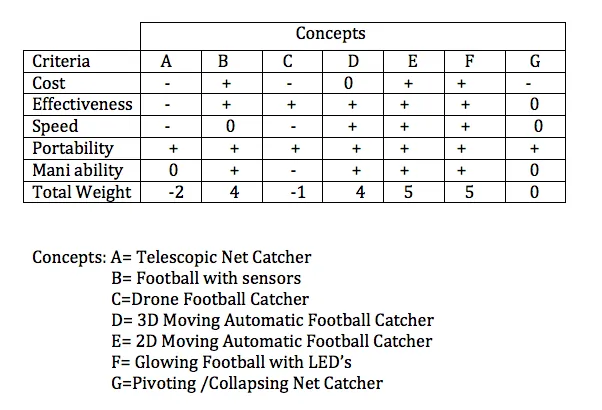
Execution
- Identify relevant user requirement or criteria. The example shows very generic criteria. A real life example would be more specific
- Develop weights for each of the requirements. This is optional for weighting the scores. To this end, you can use various weighting strategies
- Generate several viable alternatives for a solution
- Select one of the alternatives as a baseline in order to establish the current state
- Evaluate each alternative against the baseline scoring it as positive, negative or equal in meeting the criteria
- Total the values from each alternative, multiplying each value by its weight if the optional scoring mechanism was used. (See step 2)
- Combine the best elements of each alternative to create an optimal hybrid solution
Good practices
It is best if you use a team to do the Pugh Matrix. Here are a few tips to make the process go smoothly.
Carefully choose the evaluation criteria
Don't use too many criteria otherwise you can slow the process down. Remember that this is a first screening and not a final in-depth analysis. The evaluation criteria you choose are rarely of equal importance when assessing an improvement opportunity. It's key to give more or less importance based on some assumption of how much the evaluation criteria will play into the final solution.
Select a consistent rating and weighting scheme
Make sure that everyone, including your client, understands the scheme you want to use. Be sure that you operationally define the weighting system. You can use a number format or a percent e.g. from 1 to 5 or from 1 to 10. The more important the criterion is, the higher the weighting. Accordingly, the more gradations there are, the more precise your criteria weighting will be. Ideally, you should weigh the evaluation criteria before evaluating the solution concepts. As an extension, you could also weight categories.
Look for the strengths and weaknesses
Build on the positives and evaluate what you might be able to do to turn the negatives to a positive. You can use the Pugh Matrix to select the best improvements from various alternatives. First, you want to identify the factors that are most important to you. Subsequently, select one improvement as the baseline, and then weigh the criteria as to their relative importance. Eliminate those improvement concepts that clearly have few positives. Finally, focus on the positives and eliminate or mitigate the negatives for the improvement that appears superior after the first round. You can use the matrix results to spur another round of improvement.
As with any weighted decision matrix, the Pugh matrix cannot guarantee that all criteria, weightings and assessments are objectively selected and made. Nevertheless, the Pugh Matrix tries to objectify decision making and is therefore universally applicable in many areas. The special thing about the Pugh Matrix is the pairwise comparison, in which an alternative is always compared with the basic concept. This can lead to a very precise differentiation.
Citation
Cite this article
Sridharan, M. A. (2019, October 18). Pugh Matrix. Think Insights. https://thinkinsights.net/consulting/pugh-matrix (Accessed [[ACCESS_DATE]])
Sridharan, Mithun A. "Pugh Matrix." Think Insights, 18 Oct. 2019, https://thinkinsights.net/consulting/pugh-matrix. Accessed [[ACCESS_DATE]].
Mithun A. Sridharan, "Pugh Matrix," Think Insights, October 18, 2019, https://thinkinsights.net/consulting/pugh-matrix. Accessed [[ACCESS_DATE]].
Sridharan, M.A. (2019) 'Pugh Matrix', Think Insights. Available at: https://thinkinsights.net/consulting/pugh-matrix (Accessed: [[ACCESS_DATE]]).
M. A. Sridharan, "Pugh Matrix," Think Insights, 2019. [Online]. Available: https://thinkinsights.net/consulting/pugh-matrix. [Accessed: [[ACCESS_DATE]]].
Sridharan MA. Pugh Matrix. Think Insights. Published October 18, 2019. Accessed [[ACCESS_DATE]]. https://thinkinsights.net/consulting/pugh-matrix
Test Your Knowledge
Pugh Matrix
Challenge yourself on the concepts from this article and see how well you understood them.
Subscribers get weekly quizzes and insights — subscribe free
Sponsor this article
Partner with Think Insights
Reach 50,000+ business leaders, consultants, and strategists. Feature your brand alongside expert articles on strategy, leadership, and digital transformation.
Become a Sponsor