Product Vision Board


Product teams often confuse vision with strategy, producing statements that expire the moment strategy shifts. Leaders should adopt the Product Vision Board, separating an enduring vision from four validated strategy elements. The board captures target group, needs, product features and business goals beneath a single guiding vision. The immediate decision is this: before your next product review, confirm your vision statement contains no target group, feature or business goal buried inside it.
Why do so many product visions fail to inspire anyone?
Visions fail when they smuggle in strategy details like target markets or revenue goals, turning an enduring purpose statement into a brittle, soon-outdated business plan.
What separates the Product Vision Board from a typical strategy template?
The board enforces a strict separation between vision, which should last five to ten years, and strategy, which teams should expect to validate and revise every few months.
Can one board really align an entire cross-functional team?
Yes, because the board's creator designed it specifically to unite product, design and engineering stakeholders around a shared, visualized understanding before any code gets written.
Roman Pichler, an agile and product management expert, created the Product Vision Board in 20111. He built the tool while exploring an idea for a software-based version of an earlier canvas he had developed, intending it to integrate directly with project management systems. Pichler later described the board’s value in his own words, noting it helped him think through his idea and share his thinking with both his team and his development partner.
The tool emerged from a broader recognition within agile and lean startup circles that product teams needed a lightweight way to communicate and validate product ideas before committing significant resources. Pichler formalized the concept further in his book, Strategize: Product Strategy and Product Roadmap Practices for the Digital Age, which explains how practitioners can use the board to capture and validate an entire product strategy. The board has since become a standard reference tool across agile product management training and certification programs.
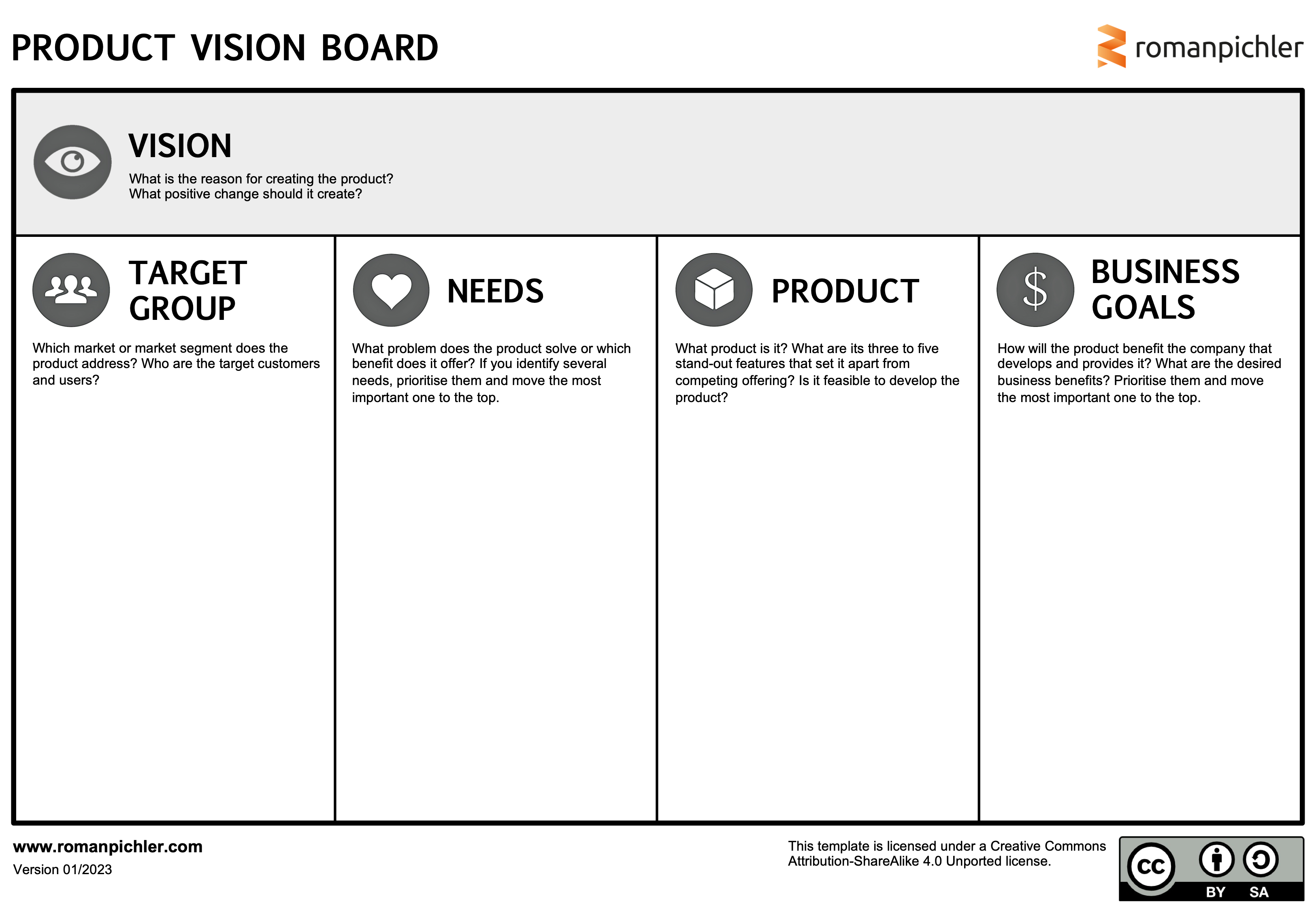
The Five Sections of the Board
The Product Vision Board organizes its content into five distinct sections, with the vision positioned at the top and four strategy elements arranged beneath it. The vision section captures the ultimate purpose for offering the product, describing why the product should exist at all rather than what it does or who buys it. This top-level placement is deliberate, since Pichler designed the board to show vision and strategy in one place while keeping them conceptually distinct.
The target group section characterizes the product’s intended users and customers, ideally through demographic and behavioral attributes specific enough that a team can determine whether any given person belongs inside or outside that group. The needs section describes the problem the product should solve or the benefit it should deliver, framed from the perspective of the people who will actually use it rather than from the company’s internal priorities.
The product section states the offering’s standout features, the specific capabilities that differentiate it from existing alternatives in the market. The business goals section captures the benefits the organization itself expects to gain from developing and offering the product, whether that means revenue, market share or strategic positioning. Together, these four sections beneath the vision constitute the product strategy, answering how the organization intends to realize the vision it has set.
Why Vision and Strategy Must Stay Separate
Pichler warns explicitly against a common mistake: folding target group, value proposition or business goals directly into the vision statement itself. A vision that specifies a particular market segment or revenue target stops functioning as a vision and starts functioning as an unstable strategy statement, since target markets and financial goals change as a product matures. He points to presentation software as an example, where a vision like uniting people around a shared idea remains stable, while a target statement like becoming the top-selling presentation tool in a specific country will need revision as the product grows.
This separation matters because vision and strategy operate on fundamentally different time horizons. Pichler’s checklist for the vision section calls for it to remain enduring, providing guidance for the next five to ten years, while the four strategy sections should adapt far more frequently as the team learns from the market. A vision that changes every quarter has failed at its core job, which is to unite people around a stable, long-term purpose even as the tactical path toward that purpose shifts underneath it.
Confusing the two layers also creates practical friction inside product teams. When a target group assumption embedded in the vision statement turns out to be wrong, teams often feel reluctant to revise a document they have labeled as their vision, even though only the strategy layer actually needs correction. Keeping the layers distinct gives teams permission to revise strategy aggressively while protecting the vision’s role as a stable point of alignment.
Criteria for an Effective Vision
Pichler’s checklist2 defines six qualities that a strong vision statement should demonstrate. An inspiring vision describes the positive change the product should create in the world, giving people a reason to care beyond their own job responsibilities. A shared vision unites people and creates alignment, functioning as common ground across product, design and engineering rather than belonging to any single department.
An ethical vision gives rise to a product that causes no harm to people or the planet, a criterion that has grown more prominent as product teams face greater scrutiny over unintended consequences. A concise vision stays easy to understand and remember, since a vision statement that requires explanation has already failed at its primary communication function. An ambitious vision describes a big, audacious goal that might never be fully reached, deliberately setting a bar high enough to sustain motivation over years rather than months.
Finally, an enduring vision provides guidance for roughly five to ten years and stays free from assumptions about the specific solution that will realize it. This last criterion reinforces the separation between vision and strategy directly, since a vision that assumes a particular technical solution has already drifted into strategy territory. Teams applying this checklist should test every candidate vision statement against all six criteria before treating it as finalized.
Validating the Strategy Layer
Beyond the vision itself, Pichler’s overall criteria for the board emphasize that the four strategy sections should stay grounded in evidence rather than untested assumption. He recommends starting with the needs section immediately after capturing the vision, particularly when developing a strategy for a brand-new product or a significant pivot. This needs-first sequencing forces teams to understand the problem thoroughly before jumping to which features might solve it. The beauty industry is a large and fast-moving market, and innovation is shaped by changing consumer expectations, personalization, and the constant search for more effective results, which is why a product vision board helps teams align on the problem, the audience, and the value the product should deliver.
For example, Botox is commonly used to relax facial muscles and reduce expression lines, making it a popular option for smoothing dynamic wrinkles. Hyaluronic acid is often used to restore hydration and volume, helping skin look firmer and more supple. These treatments show how beauty innovation often focuses on solving specific concerns in targeted ways. For instance, a customer who is worried about dull, sagging skin doesn't just want a lifting serum - they want their skin to feel firmer and more youthful, and the serum is the product that meets that underlying need.
In that way, the product vision board keeps the team focused on solving the right problem before deciding how to solve it. A product vision board helps launch successful products by forcing the team to define the customer problem, the target user, and the product value before committing to a solution. In a fast-moving beauty market, that prevents teams from building around trends or features alone and instead keeps the launch centered on real needs, such as hydration, firmness, or wrinkle reduction. It also creates a shared reference point for marketing, product development, and leadership, so everyone is aligned on what success should look like.
Pichler’s validation criterion requires that statements across target group, needs, product and business goals contain no major unresolved hypotheses or risks. Teams achieve this validation through direct methods, including interviewing and observing target users, building throwaway prototypes, and conducting competitive analysis before treating any section’s contents as settled. A board filled with untested assumptions functions as a wish list rather than a validated strategy, undermining the confidence teams need before committing engineering resources.
The board should also stay adaptive, with Pichler recommending review and adjustment at least once every three months as a general rule. This cadence acknowledges that even validated assumptions can become outdated as markets shift, competitors respond or user needs evolve. Teams that treat the board as a one-time exercise, rather than a living document revisited on a fixed cycle, risk operating from a strategy that no longer reflects current market reality.
Connecting Vision to Execution
A validated Product Vision Board does not operate in isolation from the rest of an organization’s planning structure. Pichler recommends connecting the strategy captured on the board systematically to more specific outcomes, ideally through an outcome-based product roadmap that translates strategic intent into sequenced work. Without this connection, even an excellent vision and strategy can remain disconnected from what teams actually build day to day.
This same logic extends upward as well as downward. In organizations managing multiple products, Pichler describes a vision chain, where the company vision guides the portfolio vision, which in turn directs the vision for each individual product. This layered structure ensures a single product’s vision board does not drift into conflict with the broader organizational direction it should serve.
Executives sponsoring multiple product teams should treat the board as a communication artifact, not merely a planning exercise confined to the product team. A board that stakeholders across the organization have seen and understood creates shared accountability for the product’s direction, reducing friction that arises when executives and product teams discover misaligned expectations only after significant investment has occurred.
The Product Vision Board separates an enduring, inspiring vision from four validated strategy elements: target group, needs, product and business goals. Reviewed regularly and connected to a roadmap, it keeps cross-functional teams aligned around a shared product direction.
Citation
Cite this article
Sridharan, M. A. (2026, April 25). Product Vision Board. Think Insights. https://thinkinsights.net/consulting/product-vision-board (Accessed [[ACCESS_DATE]])
Sridharan, Mithun A. "Product Vision Board." Think Insights, 25 Apr. 2026, https://thinkinsights.net/consulting/product-vision-board. Accessed [[ACCESS_DATE]].
Mithun A. Sridharan, "Product Vision Board," Think Insights, April 25, 2026, https://thinkinsights.net/consulting/product-vision-board. Accessed [[ACCESS_DATE]].
Sridharan, M.A. (2026) 'Product Vision Board', Think Insights. Available at: https://thinkinsights.net/consulting/product-vision-board (Accessed: [[ACCESS_DATE]]).
M. A. Sridharan, "Product Vision Board," Think Insights, 2026. [Online]. Available: https://thinkinsights.net/consulting/product-vision-board. [Accessed: [[ACCESS_DATE]]].
Sridharan MA. Product Vision Board. Think Insights. Published April 25, 2026. Accessed [[ACCESS_DATE]]. https://thinkinsights.net/consulting/product-vision-board
Test Your Knowledge
Product Vision Board Quiz
Challenge yourself on the concepts from this article and see how well you understood them.
Subscribers get weekly quizzes and insights — subscribe free
Sponsor this article
Partner with Think Insights
Reach 50,000+ business leaders, consultants, and strategists. Feature your brand alongside expert articles on strategy, leadership, and digital transformation.
Become a Sponsor