The Bradley Curve


Organizations often treat safety as a compliance function rather than a maturing culture. Leaders should apply the Bradley Curve, diagnosing whether their safety culture sits at Reactive, Dependent, Independent or Interdependent, then investing specifically in what moves it forward. Injury rates fall as organizations progress through these stages, but only when leadership actually shifts responsibility rather than adding rules alone. The immediate decision is this: before your next safety initiative, diagnose your organization's actual stage on the curve, since the intervention that works at one stage often fails at another.
Why do organizations with extensive safety rules still experience high injury rates?
Rules alone reflect the Dependent stage, where compliance relies on supervision and discipline rather than genuine personal or shared responsibility, and injury rates often plateau until culture matures beyond rule enforcement alone.
What separates the Independent and Interdependent stages from each other?
Independent reflects individuals taking personal responsibility for their own safety, while Interdependent reflects teams actively caring for one another and collectively managing safety, a meaningfully higher level of shared accountability.
Is the Bradley Curve considered scientifically definitive, or does it face criticism?
The model faces genuine criticism for presenting culture as a clean linear progression while offering little insight into how hazards are actually designed, introduced or controlled at a technical level.
DuPont developed the Bradley Curve in 1995, naming it after Vernon Bradley, the DuPont safety professional credited with its creation.1 The model emerged partly from a plant manager’s interpretation of principles drawn from Stephen Covey’s work on personal and organizational effectiveness, adapting ideas about individual maturity and interdependence into a framework specifically for workplace safety culture.
DuPont brought particular credibility to this effort, having reduced its own injury rate from catastrophically high levels during the nineteenth century down to near zero through decades of systematic culture development. According to safety researcher Fleming, writing in 2001, the Bradley Curve represented the first maturity model developed specifically to assess safety culture, predating several related frameworks that followed a similar staged structure.2
The model’s core purpose is to give organizations a shared, staged language for describing safety culture maturity, since vague calls to improve safety culture mean different things to different stakeholders within the same organization. A safety coordinator might interpret that call as more training, a project manager as fewer incidents, and an owner as lower insurance premiums. The Bradley Curve exists to align these different interpretations around a common, staged understanding of what maturity actually looks like and what the next step toward it requires.
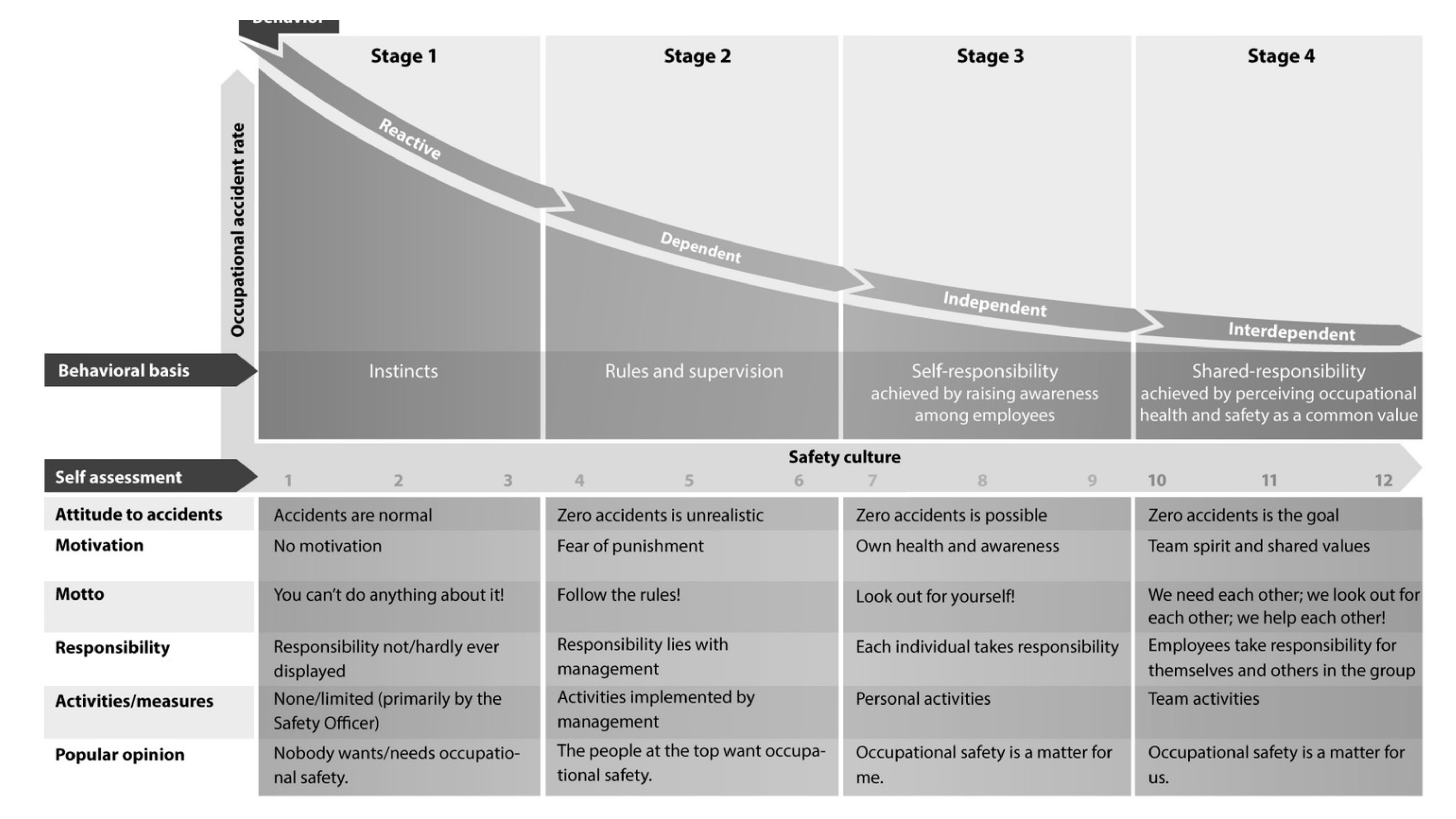
The Four Stages of the Curve
The Reactive stage represents the least mature end of the curve, where safety is addressed only after people get hurt, and compliance depends heavily on direct supervision rather than any internalized commitment. Organizations at this stage often treat accidents as an inevitable, largely unavoidable cost of doing business, and workers behave safely mainly when someone in authority is actively watching. Injury rates tend to run highest at this stage, since no genuine safety instinct exists beyond immediate supervision.
The Dependent stage follows, characterized by safety that is fundamentally rule-based, with compliance enforced through supervision and discipline rather than personal conviction. Systems and procedures exist formally on paper, and management attention focuses primarily on fixing problems reactively after incidents occur rather than preventing them proactively beforehand. This stage represents genuine progress over Reactive, since formal systems now exist, but those systems still depend heavily on external enforcement rather than anything employees have internalized themselves.
The Independent stage marks a meaningful shift, where individuals begin taking personal responsibility for their own safety, driven by internalized knowledge, genuine commitment and personally held standards rather than external supervision alone. Workers at this stage follow safe practices because they have adopted safety as a personal value, not merely because a supervisor happens to be present. The Interdependent stage represents the model’s most mature endpoint, where teams actively care for one another and collectively manage safety together, extending personal responsibility outward into genuine concern for colleagues’ wellbeing as well as one’s own.
The Relationship Between Culture and Injury Rates
The Bradley Curve’s central empirical claim holds that injury rates decline in a predictable pattern as an organization progresses through these four stages, while other performance dimensions, including quality, efficiency and overall productivity, tend to improve alongside safety rather than trading off against it.3 This correlation gives safety leaders a business case that resonates beyond the safety function alone, since it reframes safety investment as connected to broader operational performance rather than existing as an isolated cost center competing against other priorities.
This relationship matters practically because it counters a common executive assumption that safety investment inevitably trades off against production speed or cost efficiency. The Bradley Curve’s framing suggests instead that organizations experiencing frequent safety disruptions, near-misses and incidents are simultaneously absorbing costs and inefficiencies that a more mature safety culture would eliminate, meaning safety and operational performance advance together rather than existing as competing priorities that require constant tradeoffs.
Executives should nonetheless treat this correlation with appropriate caution rather than assuming it holds identically in every context. Correlation between culture maturity and injury rate does not by itself specify which particular interventions actually drive an organization from one stage to the next, and organizations sometimes invest heavily in culture initiatives without seeing the injury reduction the model implies should follow automatically.
Diagnosing an Organization’s Current Stage
Organizations seeking to apply the Bradley Curve productively need a structured way to diagnose their current position, since most safety professionals can name which stage they believe their organization occupies, but far fewer can specify concretely what actions would move them toward the next one. Structured survey frameworks have emerged specifically to fill this diagnostic gap, assessing dimensions such as individual understanding and adherence, facility management, and communication quality, then mapping the resulting scores against the four Bradley Curve stages.
This diagnostic work typically reveals that organizations rarely sit cleanly within a single stage across every dimension simultaneously. An organization might show mature, Independent-stage individual commitment to safety while still displaying Dependent-stage reliance on management-driven compliance in specific areas like reporting near misses. Recognizing this unevenness matters, since a single blanket initiative aimed at moving the entire organization forward uniformly often misses the specific dimensions actually holding progress back.
Near-miss reporting rates, safety training completion, and standard injury metrics like the Total Recordable Incident Rate all provide useful supporting data during this diagnostic process, though none of these metrics alone fully captures the qualitative shift in personal or collective responsibility the model is ultimately trying to describe. Executives should combine quantitative metrics with genuine, direct observation of how employees actually behave when supervision is absent, since that behavior reveals whether the organization has truly internalized safety values or is merely complying under watch.
Criticism and Limitations
Despite its widespread adoption, the Bradley Curve has drawn increasingly pointed criticism in recent years, particularly regarding what the model leaves out entirely. Critics note that the curve says nothing about where hazards are actually designed into systems, where risks get introduced through specific operational decisions, or where safety controls degrade over time through neglect or drift, focusing instead almost entirely on individual and cultural attitudes toward safety. This gap matters because a workforce with genuinely excellent safety attitudes can still suffer serious incidents if the underlying physical and procedural hazards were never adequately addressed at a technical level.
The model’s linear, four-stage structure has also drawn scrutiny for presenting cultural maturity as a clean, orderly progression that may not reflect how real organizations actually develop. Critics argue the curve succeeded not primarily because it was scientifically rigorous, but because it proved organizationally convenient, offering leaders a comforting, easily communicated roadmap that suggests culture can be reliably engineered through the right combination of rules, training and motivation.
Research has also found that behavior-based safety programs closely associated with the Bradley Curve framework, while effective at moving organizations out of the least mature stages, are rarely sufficient on their own to sustain excellence at the highest levels, with some evidence suggesting prolonged reliance on these programs can even decrease their effectiveness over time. Executives should treat the Bradley Curve as one useful diagnostic lens among several, pairing it with more technically grounded incident investigation methods that examine hazard design and system-level controls directly, rather than treating cultural maturity alone as a complete explanation for safety performance.
The Bradley Curve maps safety culture across four stages, Reactive, Dependent, Independent and Interdependent, correlating cultural maturity with falling injury rates and improved operational performance. Executives should diagnose their actual stage carefully and pair the model with technical hazard analysis, since culture alone cannot fully explain or resolve every safety failure.
Citation
Cite this article
Sridharan, M. A. (2026, January 29). The Bradley Curve. Think Insights. https://thinkinsights.net/consulting/bradley-curve (Accessed [[ACCESS_DATE]])
Sridharan, Mithun A. "The Bradley Curve." Think Insights, 29 Jan. 2026, https://thinkinsights.net/consulting/bradley-curve. Accessed [[ACCESS_DATE]].
Mithun A. Sridharan, "The Bradley Curve," Think Insights, January 29, 2026, https://thinkinsights.net/consulting/bradley-curve. Accessed [[ACCESS_DATE]].
Sridharan, M.A. (2026) 'The Bradley Curve', Think Insights. Available at: https://thinkinsights.net/consulting/bradley-curve (Accessed: [[ACCESS_DATE]]).
M. A. Sridharan, "The Bradley Curve," Think Insights, 2026. [Online]. Available: https://thinkinsights.net/consulting/bradley-curve. [Accessed: [[ACCESS_DATE]]].
Sridharan MA. The Bradley Curve. Think Insights. Published January 29, 2026. Accessed [[ACCESS_DATE]]. https://thinkinsights.net/consulting/bradley-curve
Test Your Knowledge
The Bradley Curve Quiz
Challenge yourself on the concepts from this article and see how well you understood them.
Subscribers get weekly quizzes and insights — subscribe free
Sponsor this article
Partner with Think Insights
Reach 50,000+ business leaders, consultants, and strategists. Feature your brand alongside expert articles on strategy, leadership, and digital transformation.
Become a Sponsor