You don't need a Data Science Team


Organizations could monitor their data, track metrics, and build dashboards, but when it came to answering deeper questions — why something changed, whether it was expected, or how patterns were evolving — the work was typically handed over to data scientists. That division made sense when the tools required for analysis were complex and disconnected from operational systems. But it also created a gap. Most teams could see their data, yet only a few could actually interpret it.
What is time series analysis and why does it matter for business teams?
Time series analysis examines how data changes over time, revealing trends, seasonal patterns, and recurring behaviors that static dashboards cannot show.
How does embedding analysis into data platforms reduce reliance on specialists?
When analytical capabilities are built into the data platform itself, engineers, analysts, and business users can explore data behavior without writing custom code or building separate models.
What is the difference between data monitoring and data analysis?
Data monitoring tracks whether metrics change. Data analysis explains why they change and whether a shift is significant, expected, or part of a known pattern.
Can non-technical teams realistically interpret time-based data patterns?
Yes, when pattern recognition and trend detection are automated within existing tools, non-technical users can interpret changes in context without requiring statistical expertise.
Does this approach replace data science teams entirely?
No. It reduces the need for data science involvement in routine, day-to-day analysis, but advanced data science remains relevant for complex or novel analytical challenges.
In many businesses today, access to data is no longer the challenge. Dashboards are widely available, reports are automated, and key metrics are continuously tracked.
What remains difficult is understanding what those metrics mean over time.
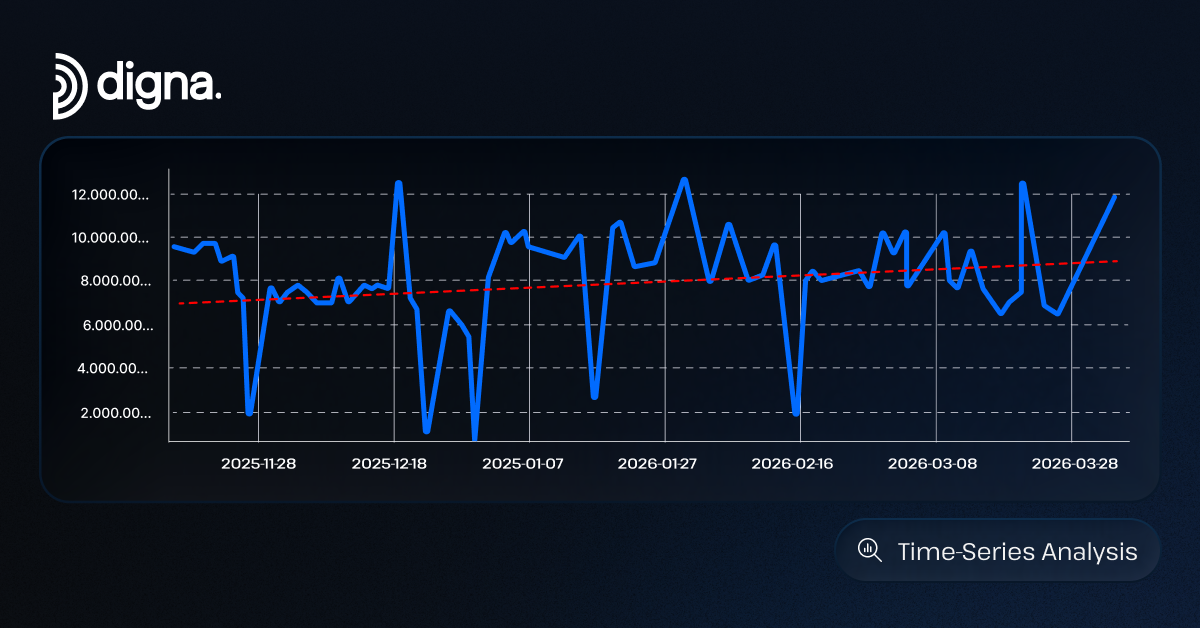
A sudden increase in activity may look like growth, but it could also be part of a recurring pattern. A drop in performance may appear concerning, but it might simply reflect normal variation. Without context, it is difficult to know whether a change is significant or expected.
This is where traditional approaches begin to fall short. They show what happened, but not how that behavior fits into a larger pattern.
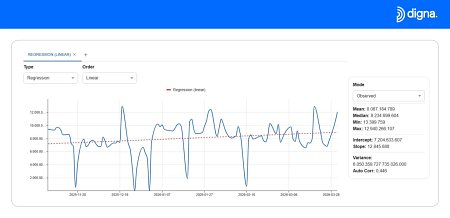
Data rarely changes in simple ways. It shifts gradually, often following patterns that are not immediately visible:
- Some changes are seasonal
- Others emerge over time as systems evolve or user behavior shifts
In many cases, what appears to be an anomaly is actually part of a larger, repeating structure.
Understanding this requires looking beyond individual data points and examining how data behaves across time. That has historically required specialized tools and statistical expertise, making it inaccessible to most business teams.
Observing data across time reveals patterns that static dashboards cannot capture.
A Shift Toward Built-In Analysis
What is changing now is not the importance of analysis, but how it is delivered.
Instead of separating data monitoring from data analysis, newer approaches are bringing these capabilities together within the same environment. This makes it possible to explore trends, identify patterns, and interpret changes without relying on external tools or specialized workflows.
Time-series analysis, which once required dedicated data science resources, is becoming part of everyday data operations. Trends can be examined directly, patterns can be recognized automatically, and deviations can be understood in context.
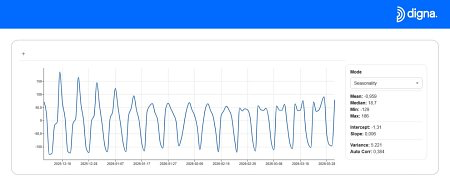
Identifying recurring patterns helps distinguish expected behavior from meaningful anomalies.
From Detection to Interpretation
This shift fundamentally changes how organizations work with data.
Instead of reacting to isolated alerts, teams can begin to understand the behavior behind them. A change is no longer just something to investigate, but something that can be explained.
This reduces uncertainty. It allows teams to move beyond guesswork and make decisions based on patterns rather than assumptions.
Reducing the Need for Specialized Teams
One of the most significant effects of this change is the reduced reliance on data science teams for routine analysis.
When analytical capabilities are embedded directly into the data platform, the ability to understand data is no longer limited to a small group of specialists. Engineers, analysts, and business users can all explore how data behaves without building custom models or writing code.
This does not replace advanced data science, but it removes the need for it in everyday decision-making.
A More Practical Way Forward
As data environments continue to grow, organizations are looking for ways to simplify how they work with data, not add more complexity.
Bringing time-based analysis closer to where data already exists is part of that shift. It allows teams to respond faster, understand changes more clearly, and operate with greater confidence.
In this context, understanding data is no longer a specialized task. It becomes a natural extension of working with data itself.
Platforms such as digna are beginning to integrate these analytical capabilities directly into data environments, making this shift increasingly practical for organizations.
The real challenge for most organizations is no longer collecting or visualizing data. It is interpreting how that data behaves over time.
As analytical capabilities become more integrated and accessible, the gap between seeing data and understanding it begins to close. And with that, the reliance on specialized teams for everyday insights starts to diminish.
Citation
Cite this article
Sridharan, M. A. (2025, July 28). You don't need a Data Science Team. Think Insights. https://thinkinsights.net/community/you-dont-need-data-science-team (Accessed [[ACCESS_DATE]])
Sridharan, Mithun A. "You don't need a Data Science Team." Think Insights, 28 July 2025, https://thinkinsights.net/community/you-dont-need-data-science-team. Accessed [[ACCESS_DATE]].
Mithun A. Sridharan, "You don't need a Data Science Team," Think Insights, July 28, 2025, https://thinkinsights.net/community/you-dont-need-data-science-team. Accessed [[ACCESS_DATE]].
Sridharan, M.A. (2025) 'You don't need a Data Science Team', Think Insights. Available at: https://thinkinsights.net/community/you-dont-need-data-science-team (Accessed: [[ACCESS_DATE]]).
M. A. Sridharan, "You don't need a Data Science Team," Think Insights, 2025. [Online]. Available: https://thinkinsights.net/community/you-dont-need-data-science-team. [Accessed: [[ACCESS_DATE]]].
Sridharan MA. You don't need a Data Science Team. Think Insights. Published July 28, 2025. Accessed [[ACCESS_DATE]]. https://thinkinsights.net/community/you-dont-need-data-science-team
Test Your Knowledge
You don't need a Data Science Team
Challenge yourself on the concepts from this article and see how well you understood them.
Subscribers get weekly quizzes and insights — subscribe free
Sponsor this article
Partner with Think Insights
Reach 50,000+ business leaders, consultants, and strategists. Feature your brand alongside expert articles on strategy, leadership, and digital transformation.
Become a Sponsor